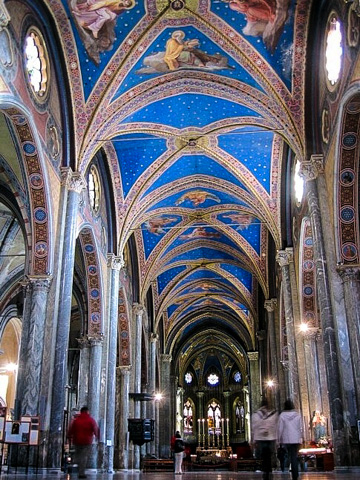
Rome's only Gothic church was built in 1280 over the site of a Temple to Minerva (hence the name, "St. Mary over Minerva").
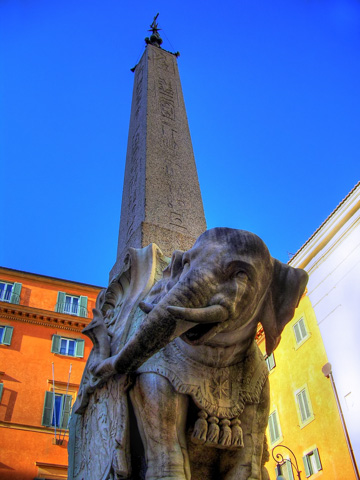
The piazza out front sports a whimsical statute by Bernini of a baby elephant (1667) carrying a miniature Egyptian obelisk on its back. (This was a theme Bernini had been dying to try for several decades, but never got the chance until Pope Alexander VII commissioned him to create a base for this obleisk, discovered near the site.)
The church interior was heavily restored in the 19th century—though keeping (mostly) to the original, spare Gothic style—and contains some masterpieces by Tuscan Renaissance artists and the bodies of important Tuscan Renaissance personalities.
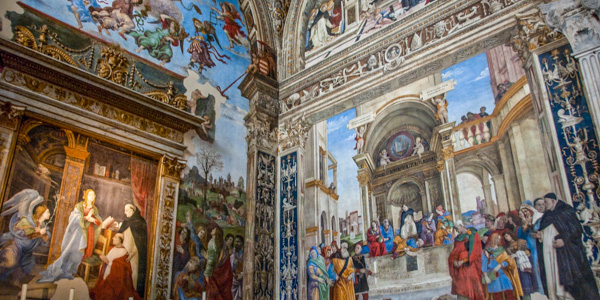
The last chapel on the right retains a sumptuous cycle of frescoes by Filippino Lippi (a detail is pictured at the top of the page).
on the lower half of the chapel's right wall is a scene of St. Thomas Condemning the Heretics. The two boys in the group on the right are portraits of Giovanni de' Medici and Giulio de' Medici.
These two would grow up to become Popes Leo X and Clement VII, respectively, and are buried in the apse in tombs by Antonio Sangallo the Younger.
Under the altar lies the body of the pious medieval activist and Dominican nun St. Catherine of Siena (1347–1380), a skilled theologian and diplomat whose letters and visits were instrumental in returning the papacy from Avignon to Rome.
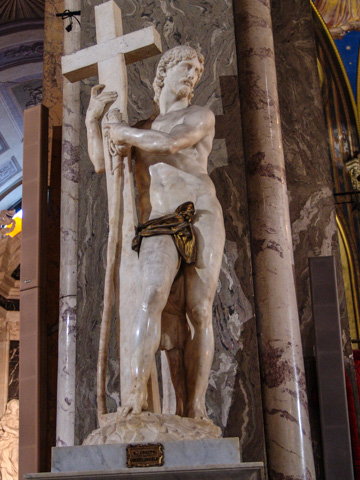
To the left of the altar steps is Michelangelo's muscular Risen Christ (1514–21), leaning nonchalantly on a diminutive Cross (such a strong, virile, and quite naked Christ wasn't to everyone's taste, and the church later added a sweep of bronze drapery to cover the Lord's loins).
In a corridor to the left of the choir, behind a small fence, is the tomb slab of the early Renaissance master and devout monk Fra' Angelico, who died in the attached convent in 1455.
Pope Nicholas V, who had commissioned a Vatican chapel from the painter 10 years earlier and was touched by the little monk's piety, modesty, and skill, wrote the epitaph himself.
Piazza della Minerva 42
tel. +39-06-6992-0384
www.basilicaminerva.it
Mon–Fri 7:30am–7pm
Sat 7:30am–12:30pm,
3:30pm–7pm
Sun 8:30am–12:30pm and 3:30pm–7pm
Free
Roma Pass: No
Planning your day: You can see the church in about 20–30 minutes.
Take a guided tour of Santa Maria sopra Minerva with one of our partners:
You can attend services at Santa Maria sopra Minerva Monday to Fridays at 8:15am and 6pm; Saturdays at 6pm; Sundays at 10am, 11am, noon, and 6pm.
Share this page
Search ReidsItaly.com
Piazza della Minerva 42
tel. +39-06-6992-0384
www.basilicaminerva.it
Mon–Fri 7:30am–7pm
Sat 7:30am–12:30pm,
3:30pm–7pm
Sun 8:30am–12:30pm and 3:30pm–7pm
Free
Roma Pass: No
Bus: 116, 116T; 53, 62, 63, 81, 83, 85, 117, 119, 160, 160F, 175, 492, 628, C3, N4, N5, N6, N12, N25
Hop-on/hop-off: Fontana Di Trevi



This article was written by Reid Bramblett and was last updated in March 2014.
All information was accurate at the time.
about | contact | faq
» THE REIDSITALY.COM DIFFERENCE «
åß
Copyright © 2008–2017 by Reid Bramblett. Author: Reid Bramblett