Paestum trip planner
Three Greek temples sprouting from the middle of mozzarella country on Campania's Cliento Coast
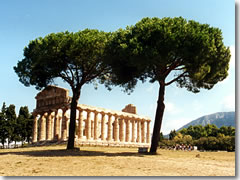
The Temple of Athena at Paestum. (Photo courtesy of Michael Johanning.)It's amazing to think that a culture could misplace three entire ancient Greek temples and forget about them utterly for nearly a millennia, but that’s what happened when malaria and pirates drove the AD 9th century citizens of Paestum into the hills.
Time forgot the crumbling ruins of this city founded in the 7th century BC until the 18th century, when a road crew rediscovered its remarkably well-preserved temples hidden among the weeds and poppies.
History of Paestum
Poseidonia, or the City of Poseidon, was founded in the 6th century BC by Greek colonists from Sybaris. It trucked along nicely as the Roman colony of Paestum after 273 BC, and gained a small measure of fame for its enormous roses (which continue to bloom twice a year in gardens around the site).
Map
Here's a pdf map of the archaeological area.But malaria decimated the population, and in the 9th century the Saracens wiped it off the map and out of memory. It wasn't until the 18th century while building a road through the area that anyone other than farmers stumbled across the three incredible temples jutting out the of landscape, surrounded by blue-gray mountains.
Paestum Scavi (Archaeological Site)
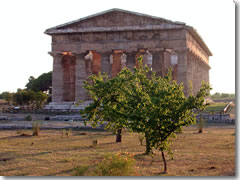
The "Temple of Neptune" at Paestum.Amid the grasses stained with poppies and crisscrossed by the low stone walls that outline the remains of the ancient city rise three mighty temples, all of which still go by their erroneous old names.
The modestly sized Basilica was actually a Temple of Hera, built in 530 BC and the oldest temple at Paestum.
Next door is the enormous and strikingly well-preserved  Temple of Neptune, in reality probably dedicated to Apollo or Zeus, built in 450 BC and one of the three most complete Greek temples in the world. Its pediments and entablature are virtually intact atop fourteen 30-foot-high fluted columns down each side, six each across the front and back, and a cella in the center divided by two more rows of smaller columns.
Farther off in the site is the Temple of Ceres, more likely a temple to Athena, and the midget of the bunch, built around 500 BC and preserving, along with all 34 of its columns, some architrave and large chunks of its pediments.
The archaeological area is open daily from 8:45am until around sunset (last entry an hour before closing). The actual closing hour ranges from 3pm to 6:30pm over the course of the year, and it literally changes—in increments anywhere from 5 to 30 minutes—every 15 days (no joke); see www.infopaestum.it for a detailed chart.
Museo Archeologico di Paestum (Archeological Museum of Paestum)
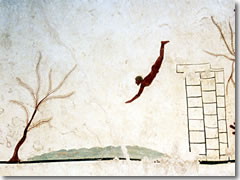
The Tomb of the Diver fresco at Paestum.Along with archaic Greek sculpture and vases, the Museo Archeologico di Paestum preserves a great series of metopes from a nearby sanctuary of Hera, which depict scenes from Homeric myth and women dancing to honor the goddess.
The museum's Tomb of the Diver paintings from 480 BC, are the only surviving examples of ancient Greek painting in the world. I would like to repeat that, since it is so significant.
These are the only 5th century BC frescoes from Ancient Greece anywhere in the world.
That alone should be reason enough to visit Paestum (and why I'm including another image of them below in the "Tips "section).
Aside from their namesake image of a bronzed youth diving into a blue sea (a symbol of the journey to the afterlife), these paintings focus on a homoerotic banquet scene in which the revelers play at games and musical instruments (and at flirting) while reclining on couches.
The museum is open daily 8:30am to 6:45pm (though closed the first and third Mondays of each month). Admisison is €10.
Departing from and returning to your hotel on the Amalfi Coast, first stop will be the Tenuta Vannulo, a farm in the heart of the Campania region where mozzarella di bufala is still produced in a traditional way. You will tour the farm and learn all about the cheese-making process before sitting down to taste the freshly made cheese. At the winery Marino you will enjoy a selection of Italian specialties accompanied by some of the typical wines of the South. The three Doric temples at Paestum are said to be the best-preserved Greek temples in the world. These magnificent monuments date back to the 6th and 5th centuries B.C., and are dedicated to the city's namesake Poseidon...
Duration: 7.5 hours; Cost: rom $331 per person
...
How to get to Paestum
Paestum is in the middle of nowhere in mozzarella country, and the only signs of civilization are the postcard stands, hotels, and restaurants that a tourist site draws.
- By tour: You can take a five-hour tour from Naples to Paestum led by an archaeologist, historian, or art historian via our partners at Context Travel:
- By Train : Only local regionale trains stop at Paestum. From Salerno, 14 daily trains headed to Paestum (30–40 min.). From Naples, there are 12 daily runs (74–103 min.). Last I checked, the ticket office at Paestum's station (which sometimes goes by the confusingly long name "Capaccio Scalo/Roccadaspide - Paestum") was closed indefinitely; if this is still the case, you can still get on here and then pay the conductor on the train with no penalty.
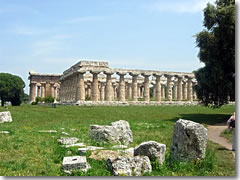
The Temples of Hera and Neptune at Paestum. (Photo courtesy of Chiara Marra.) By Bus: Hourly CSTP buses (tel. +39-800-016-659, www.cstp.it) leave Salerno from Piazza della Concordia at the waterfront—a few blocks down from the train station (and a few blocks over from where the Amalfi Coast SITA buses stop)—and let you off right at the museum in front of the archaeological site (64 min.). Departures on this Line 34 run are hourly from 6:30am–12:30pm, then at 1:50pm, 2:50pm, 3:30pm, 4:35pm, 5:45pm, and 7:30pm.
There are also four daily buses from Naples (7:30am, 8:10am, 1:30pm, and 9:10pm); that ride takes 84 min.- By Car: From Salerno, take provincial road SP175a south along the coast; the drive takes about an hour. From farther afield, take Autostrada A3 to the Battipaglia exit and follow the SS18 south ("sud") to the Paestum exit.
From the train station, you can bargain with a taxi driver (tel. +39-0828-721-107 or tel. +39-0828-722-524) for the trip to your hotel (don't go over €20). Otherwise, head out of the station and continue straight under the arch at the intersection up Via Porta Sirena. After a 15-minute, 1km (0.6-mile) stroll, the road ends at Via Magna Grecia and the archaeological site and Albergo delle Rose.
Turn right for the museum, main site entrance, dinky tourist office, and Hotel Il Granaio dei Casabelli (for which you'll then take the next left at Via Porta Aurea/Via Tavernelle). For the Nettuno restaurant, Porta della Giustizia site entrance (and, eventually, the beach): turn left, then right on Via Nettuno, for another five-minute walk.
Planning FAQ
- Paestum tourist office:
Via Magna Grecia, Paestum
tel. +39-0828-811-016, or +39-0828-721-223
Museopaestum.beniculturali.it
www.infopaestum.it
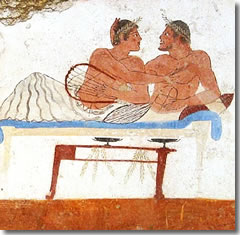
Two Greek lovers taking a break from lyre-strumming to canoodle during a symposium. Since one is bearded and the other is not, it is likely this depicts an eraste with his eromenos. From the Tomb of the Diver frescoes at Paestum.Planning your day: The Paestum site itself takes about 1–2 hours to see; the museum another 40–60 minutes. You can easily do it all in one morning by taking an early train from Naples (or leave the Amalfi Coast in the morning and head to Salerno and the connection), and lunching at the Nettuno restaurant on site before continuing on your way.- The Paestum archeological site is open daily from 8:45am until around sunset (last entry an hour before closing). The actual closing hour ranges from 3pm to 6:30pm over the course of the year, and it literally changes—in increments anywhere from 5 to 30 minutes—every 15 days (no joke); see www.infopaestum.it for a detailed chart.
The Paestum museum is open daily 8:30am to 6:45pm, but closed first and third Mon of every month.
- Mmm, mozzarella: These plains of the Cliento coast are the epicenter of Italy's mozzarella production, so be sure order some at lunch to indulge in the freshest mozzarella you'll ever taste. To visit some of the mozzarella farms, see the next tip about the beach..
- The nearby beach: If you fancy a dip in the sea after a hot morning at the ruins, follow signs marked "mare" for the beach, about a 20–30 minute walk from Porta della Giustizia.
Along the way you'll pass mozzarella farms where "vendita diretta" signs indicate they'll sell you dripping bocconcini (balls) of cheese made fresh that morning—usually within 300 feet of the scenically grazing bufale that provided the milk. (The yogurt, honey, and fresh ricotta are excellent as well.) » more
Tips & links
Details
How long does Paestum take?
Planning your time: Give yourself at least a good 2–3 hours at the site and museum—after all, you made the effort and came all this way.
Unelss you can knock it off first thing in the morning, make Paestum an afternoon activity, starting with lunch, then some beach time (and mozzarella time), holding off on the museum and archaeological site until things cool off in the later afternoon—plus, this way you get to watch the sunset light up the stones of the ruins before turning in for the night then moving on the morning.
» Paestum itineraries
Amalfi Coast tours
Useful links & resources
- Airport transfers (Rome):
- Bus (total: €28–€30; 5+ hr): Marozzivt.it (bus Sorrento-Roma Tiburtina; €20–€22; 4 hr) + Trenitalia.com (train Tiburtina-airport; €8, 48 min)
- Private (€65–€120; 3 hr): Viator.com (note: Rome airport or hotel to Sorento or any Amalfi Coast town)
- Regional rail & access points
- Circumvesiviana train (Naples-Sorrento): Eavsrl.it
- Italian rail (Naples-Salerno): Trenitalia.com
- [The Amalfi Coast itself has no rail service, only bus and boat. Sorrento is the closest train station to the most popular A.C. towns, and the over-the-sea Sorrento-Salerno bus ride is more spectacular than the cliff-hugging Salerno-Sorrento reverse route.]
- Car resources
- Emergency service/tow: tel. 803-116
- Highway agency: Autostrade.it (traffic info, serivce areas, toll calculator, weather)
- Italian automotive club (~AAA): Aci.it
- ZTLs: Ztl-italia.blogspot.com (lightly outdated, but handy, links to cities' traffic-free zones)
- Ferries & hydrofoils
- Alicost.it (Sorrento-Positano-Amalfi; Capri-Positano-Amalfi-Salerno)
- Travelmar.it (Positano-Amalfi-Salerno; Amalfi-Minori-Maiori)
- Alilauro.it (connecting Sorrento and Naples, Amalfi, Positano, Capri, or Ischia; also connecting Amalfi, Positano, or Salerno with Capri or Ischia)
- Gescab.it (connecting Capri with: Sorrento, Positano, Amalfi, Salerno)
- Coopsantandrea.com (Sorrento-Positano-Amalfi-Minori-Maiori-Salerno; Amalfi-Capri)
- Caremar.it (Sorrento-Capri; Naples-Capri)
- Private boat transfer (Naples-Sorrento, Naples-Amalfi)
- Viator.com
Share this page

Search ReidsItaly.com