Amalfi trip planner
A travel guide to the Amalfi Coast town of Amalfi
Via delle Repubbliche Marinare/Corso Roma 19, Amalfi
tel. +39-089-871-107
www.amalfitouristoffice.it
Useful private sites:
www.amalficoast.com (cooking classes, hiking paths, recipes, boat rentals)
www.amalficoastweb.com (photos, videos, hiking maps)
www.positanonews.com (news)
Buses: www.sitabus.it
Ferries: www.metrodelmare.com
From Naples
• Private tour of Sorrento, Positano, Amalfi, and Ravello from Naples
• Pompeii and Sorrento Day Trip from Naples
• Context: Monti Lattari Hike from Naples
From Sorrento
• Amalfi Coast Private Day Tour from Sorrento
• Sorrento Shore Excursion: Positano, Amalfi and Ravello Day Trip from Sorrento
• Sorrento Shore Excursion: Pompeii, Positano and Sorrento Day Trip from Sorrento
• Sorrento Shore Excursion: Positano, Sorrento and Amalfi Day Trip from Sorrento
From Rome
• Pompeii and Amalfi Coast Small Group Day Trip from Rome
From Salerno
• Salerno Shore Excursion: Private Day Trip to Sorrento, Positano and Amalfi from Salerno
★★ Residenza del Duca [€€–€€€]
★ Hotel Marina Riviera [€€€€]
★ Hotel Miramalfi [€€€]
Hotel Amalfi [€€–€€€]
Albergo Sant'Andrea [€€]
» More hotels in Amalfi [from €55]
» B&Bs in Amalfi [from €69]
» Apartments in Amalfi [from €60]
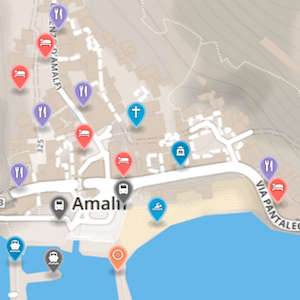
ReidsItaly.com Amalfi Coast Map
View Larger Map
Naples & Campania tours


Amalfi Guide
See
Swim
Stay
Eat
Planning FAQ
What do coffee, St. Andrew the Apostle, papermaking, compasses, and the Knights of Malta all have in common?
The answer: Amalfi, a tiny coastal town that, believe it or not, was once Western Europe's gateway to the wider world.
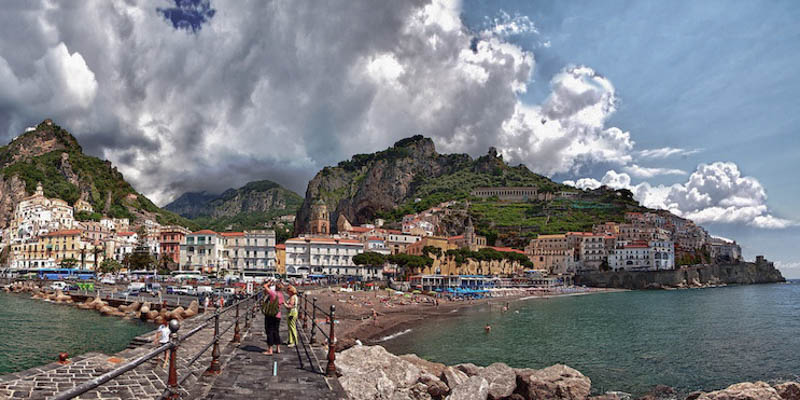
The whitewashed streets of the once-great maritime port of Amalfi are full of history, recalling a time in the Middle Ages when it rivaled Genoa, Pisa, and Venice as a trading behemoth.
Most modern visitors look at this little fishing town by the sea and wonder how it ever could have laid claim to such fame, since cities like Venice and Genoa are clearly much larger.
There's a reason for that. Amalfi used to be much, much bigger:
Amalfi's proud history

A statue of Flavio Gioia at the harbor.Amalfi's connections with the Orient stuffed its coffers with trade goods and made it the gateway to Europe for such Arab innovations as paper, coffee, carpets, and the compass—though Amalfi (all historical evidence to the contrary) still proudly claims they themselves invented that last one.
They've even erected a statue in the middle of the piazza at the port of hometown boy Flavio Gioia said to have fabricated the first compass. (Patently untrue; he might have popularized it, but the compass was undoubtedly an Arab invention, introduced to the West by Arab sailors—conceivably, yes, via the busy port of Amalfi.)
Amalfi again entered history when a local monk, backed by Amalfitani merchants, founded a hospital in Jerusalem along with a benevolent order that later became known as the Knights of Malta—today the only surviving order of knights from the Crusader age.
At its height, Amalfi had a population of 70,000 and lorded it over the Thyrrhenian Sea. Then the troubles began.
The Normans gave the town a whooping in 1131, and soon after Pisa swept in to trounce its rival twice.
The final blow came in 1343, when a one-two combination of tidal waves and earthquakes slumped much of the grand city into the sea, erasing most of the city from existence and decimating the population. And I do mean "decimating."
That's an oft misused word. "Decimating" means, literally, the act of reducing to one-tenth the previous size. When an army of 1,000 sets out to battle and only 100 soldiers return, they have been "decimated." Well, Amalfi had nearly 70,000 inhabitants before the earthquake and tidal wave. Ever since, it has struggled to maintain a population of 6,000.
Why visit Amalfi?

The Arab-styled, whitewashed, often covered back alleys of AmalfiAmalfi is now a much reduced little resort town of 6,000 inhabitants, but left over from its glory days are a spectacular 
Duomo and the Tavole Amalfitane, the western world's first maritime code, a set of laws that continued to rule trade and the sea until 1570.
After you've ogled the Duomo while sipping cappuccino from a strategic cafe in the piazza, wander up the main drag Via Lorenzo di Amalfi into the Valle dei Mulini to watch the last paper-maker at work in his shop, and on your way back down detour off the main road to explore the marvelous maze of whitewashed tunnels and alleyways that make up the North African–style casbah of Amalfi's back streets. » more
Tips
- Planning your time: Amalfi (the town) is the perfect spot to overnight on the Amalfi Coast. The cathedral is the only real "sight" of note, and can be knocked off in 20 minutes, but is is also one of the few noteworthy "sights" along the entire coast—plus the secondary sights are interesting, and the town is just large enough to keep the feeling that there's a bit of local life beyond the tourism, making it a joy to wander (the others—Positano and Ravello especially, may be more postcard-quaint and pretty, but Amalfi feels more real). Add to that the fact that (a) this is the coast's main town with the largest share of tourist facilities (hotels, restaurants, etc.), and (b) this is where you have to switch buses anyway, Amalfi makes for a convenient spot to spend the night.
- How to get to Amalfi: See the "Getting around the Amalfi Coast" page.
- Visitor information: The Amalfi tourist office is at Via delle Repubbliche Marinare/Corso Roma 19—standing in the main harborfront square, Piazza Flavio Gioia, with your back to the sea, head right up the main coastal road 100 yards or so; its on the left, hidden at the back left corner of a lovely little interior courtyard (tel. +39-089-871-107, www.amalfitouristoffice.it).
- Amalfi town is the turnstile for coastal public transportation. If you're traveling the Amalfi Coast by bus, you always have to get off in Amalfi at the main harborfront Piazza F. Gioia and switch to another bus to continue on, as this is the central terminus for buses from Sorrento and Positano to the west/north, Ravello up in the hills, and Vietri and Salerno to the east/south. If you're driving, there's public parking lot by the port.
- Hint: During regular hours (10am–6:45pm) the cathedral closes its main doors and you can only enter through the Cloisters of Paradise, and therefore must pay, but you can see the Duomo for free (though not the adjacent cloisters and small museum) if you come to mass at 9am or after 6:45pm.

The crumbling remains of a medieval watchtower high above Amalfi
Related pages
- Amalfi sights
- Amalfi hotels
- Amalfi restaurants
- Amalfi Coast Guide
- Getting around the Amalfi Coast
- Nearby destinations: Positano, Ravello, Sorrento
- Sidetrips: Capri, Pompeii, Naples, Paestum
- Campania guide
This material was last updated February 2011. All information was accurate at the time.
about | contact | faq
» THE REIDSITALY.COM DIFFERENCE «
Copyright © 2008–2012 by Reid Bramblett. Author: Reid Bramblett