The ancient sights of Rome
A quick guide to the top ruins, temples, and other ancient sites in Rome, Italy
Tourist info:
www.turismoroma.it
City museums:
www.museiincomuneroma.it
Ancient sites:
archeoroma.beniculturali.it
Ancient Rome tours
• Context: Colosseum and Imperial Rome
• Skip the Line: Ancient Rome and Colosseum Half-Day Walking Tour
• Context: Roma Antica, from the Roman Forum to the Colosseum
• Ancient Rome Half-Day Walking Tour
• Capitoline Museums and Origins of Rome Walking Tour
• Imperial Rome Afternoon Tour
• Context: Caesar and Empire
• Private Tour: Ancient Rome and Colosseum Art History Walking Tour
• Private Tour: Ancient Roman Art History Walking Tour
• Context: Of Cows and Commerce (less visited ancient sights)
• Context: Underground Rome: The Hidden City
• Context: Buried Under Rome (Circo Massimo Mithraeum
• Context: Tours in the Public Interest: Archaeology in Rome (visits otherwise off-limits sights)
• Private Tour: Imperial Rome Art History Walking Tour
• Context: Fall and Rise of Rome
Ancient Rome: Family tours
• Context: Ancient Rome Discovery
• Context: How Rome Works
• Context: Underground Rome for Families
• Context: Mythology Workshop
• Context: Capitoline Museums for Families
Ancient Rome: Museum tours
• Context: Capitoline Museums
• Context: The Good Life (Palazzo Massimo)
Ancient Rome tours: Outside the center
• Context: Catacombs Excursion
• Context: Appian Way, Queen of Roads
• Context: Ostia Antica
• Context: Tivoli (Hadrian's Villa)
ReidsItaly.com Rome Map
» View ENLARGED MAP with all listings
Rome Tours & Activities
Ancient sites near the Forum and Colosseum
Sights By Category• Top Sights
• Museums
• Ancient sites / ruins
• Piazze & fountains
• Churches
• Reid's list
• Free sights
• Michelangelo's Rome
• Bernini's Rome
• Caravaggio's Rome
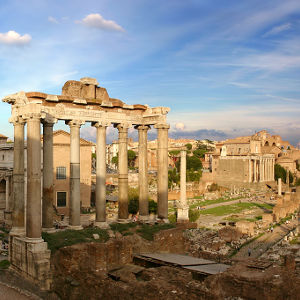
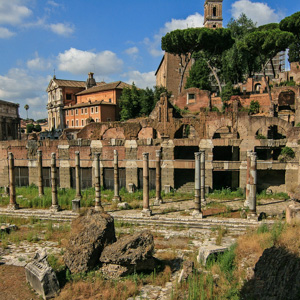
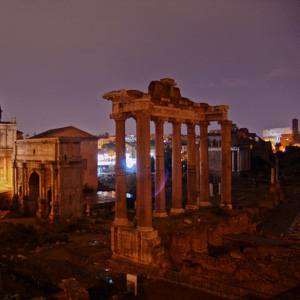
The Roman Forum ★★★ - Lines of chipped columns, crumbling triumphal arches, broken temple porticoes, the curve of abandoned marketplaces, armless statues patinaed with age—you can wander at will through the ghost city of an ancient Rome that, 2,000 years ago, ruled over the entire known world.... » more
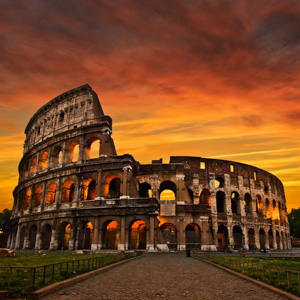
The Colosseum ★★★ - The world's greatest sports arena, where 50,000 of the masses could be amused at a time, and the contests between men—and between man and beasts—could last 100 days or more and involve the slaughter of literally thousands of animals and gladiators. Yes, ancient Rome was a cheery place... » more
Capitoline Museums ★★ - Stuffed with ancient statues and mosaics and Renaissance and baroque masterpieces by Caravaggio, Rubens, Titian, Bernini, and Tintoretto, the twinned Capitoline Museums are home to such Rome icons as the archetype statue of the she-wolf suckling the twins Romulus and Remus, Lo Spinario (boy picking thorn out of foot), the Dying Gaul, and those gargantuan marble head, hands, and feet you see on all the postcards (usually with a cat posing on them).... » more
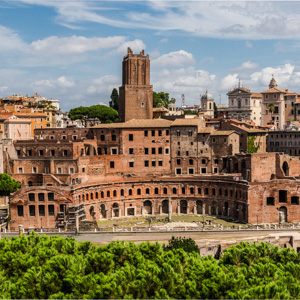
Trajan's Market ★★ - The world’s first multilevel shopping mall was built by the Emperor Trajan in the AD 2nd century. It's the only bit of the Imperial Fori consistently open to the public, offering a glimpse into real daily life in Ancient Rome. You can wander a brief but evocative section of the city's most intact ancient streets, the grand bazaar hall lined by former market stalls with marble porticos and barrel-vaulted ceilings, and the giant curving sweep of that four-story, 150-shop shopping center... ![]()
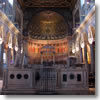
San Clemente ★★ - This early medieval church's mosaics, marbles, and Masolino frescoes would be worth a visit in of themselves. But the real show here is that you can head downstairs to see Rome's layer effect at work, exploring church layered upon church layered upon pagan temple to Mithras and ancient Roman streets and houses... » more
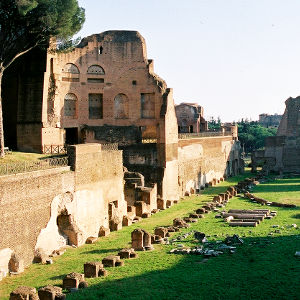
The Palatine Hill ★ - The Palatine Hill was where the legendary Romulus founded a tiny Latin village in the 8th century BC. When the hamlet grew to become Rome, patrician families and early emperors covered it in their stately mansions (called palatium after the hill, which evolved into palazzo in Italian, palais in French, and "palace" in English). It offers a scenic escape from the crowds where you can wander across the grassy floors of ancient Imperial palaces and peer down the gated passageways that were once the homes of Rome's rich and famous... » more
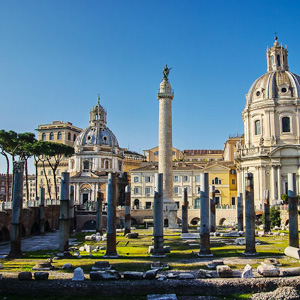
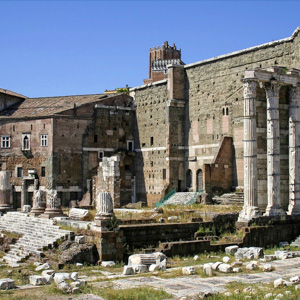
Imperial Fori ★ - The grandeur of Imperial Rome, laid out in a series of public spaces, markets, and triumphal columns by successive emperors, you can admire with a quick stroll or bike ride down Via dei Fori Imperiali: The Forum of Trajan, the Forum of Augustus, the Forum of Nerva.... » more
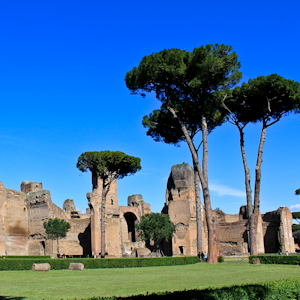
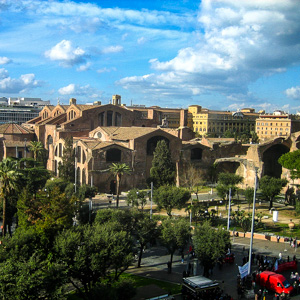
Baths of Caracalla ★ - The largest surviving ruins of an ancient baths complex in Rome is a crumbling complex of brick walls and broken archways sprawling over 33 acres that could once accommodate 1,600 bathers. It is also a spectacular setting for summertime opera and concert performances... ![]()
Domus Aurea (Nero's Golden Palace) ★ - [currently closed] After the Great Fire of AD 64, Nero seized more than 200 acres of the city's burned-out historic core to create one of the most sumptuous palaces in history, slathered in frescoes and stuccoes, with rotating banquet tables over which would drift showers of flower petals, and entire rooms laminated in gold leaf (hence the nickname). It was a party palace par excellence for an emperor who would go down in history as one of the most hated leaders of all time... » more
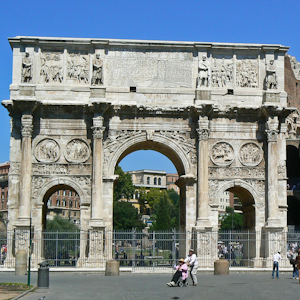
The Arch of Constantine - Standing between the Colosseum and the Roman Forum, the Arch of Constantine is one of the largest of Rome's ancient triumphal arches, celebrating Emperor Constantine the Great's AD 312 victory over Maxentius at the Milvian Bridge—which marked a seismic shift in European history, when Rome (and, eventually, Europe) started converting from pagan to Christian... » more
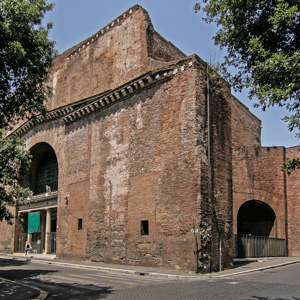
Teatro di Marcello - This early blueprint for the Colosseum survives even though medieval builders grafted a series of apartment buildings on top of it (don't tell me the Romans don't know how to recycle).... » more
The Foro Boario - The forgotten forum, a pair of teensy, utterly ancient temples slung between the back side of the Capitoline Hill and the Tiber River, across from the Mouth of Truth, in what was until modern time a cow pasture.... » more
Circus Maximus - Slung into the Murcia Valley between the Palatine and Aventine hills, the elongated grassy jogging oval known as the Circo Massimo was once the largest stadium in all of Rome, a 2,000-foot-long track where the empire threw its most extravagant chariot races to entertain crowds of up to 385,000 screaming spectators... » more
Ancient sites in the Historic Center (near Piazza Navona, the Spanish Steps, and Via Veneto)
The Pantheon ★★★ - The only ancient Roman temple to survive the millennia intact is also one of the most amazing architectural spaces in Rome, an expansive cylinder swaddled in precious marbles, topped by a vast concrete hemisphere, and pierced by a wide shaft of sunlight from the oculus at the center... » more
Piazza Navona ★★ - The odd, oblong shape of this famous, café-lined piazza splashing with Bernini fountains is due to the fact that it was built atop the ancient Stadium of Domitian. The basements of many of its Renaissance and baroque palazzi preserve ancient remains, but the only bit visible to or accessible to the public are some travertine arches under a bank building at the north end of the square (exit the piazza to the busy road beyond, turn left, walk a few feet, and peer down through the fence on your left)... » more
Largo Argentina ★ - A few steps from one of Rome's main city bus stops lies a trio of ancient temples crawling with stray cats and overflowing with weeds, and the crumbling set of steps upon which Julius Caesar was assassinated on the Ides of March.... » more
Museo Nazionale Romano: Palazzo Altemps ★ - The Palazzo Altemps branch of the Rome National Museum is perhaps the prettiest of the four branches (the other three are all up near Termini), with loads of excellent ancient sculptures and other Roman art installed in the frescoed rooms of a 16th-century palace just off the north end of Piazza Navona... » more
Ara Pacis ★ - Augustus had his "Altar of Peace" built in 13 BC to celebrate the peace brought by his unification of the Empire. Though you can peer at it through the glass walls of its enclosure, it's worth the admission to go inside and examine up close the beautiful relief panels carved with mythological figures and long processions of prominent citizens from Rome's history—carvings that represent the point at which Roman art finally significantly broke from Greek models to make a strong, classical statement all its own... » more
Tomb of Augustus - This 287-foot-wide brick cylinder crowned with a dirt mound and cypress trees once housed the remains of every Roman emperor from the first, Augustus (died AD 14), to Nerva (died AD 98), plus some family members and favored generals. Invading barbarians hordes sacked the tomb during the fall of Rome, unceremoniously dumping the imperial ashes onto the floor to make off with the urns as booty. In the Middle Ages, this became a fortress, then a baroque amphitheater for cockfights and bear baiting, and finally a concert hall until 1936... » more
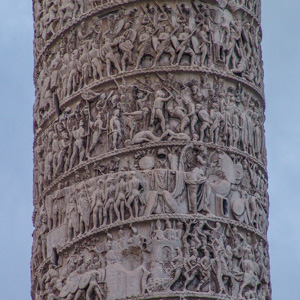
Column of Marcus Aurelius - The emperor's exploits and most famous victories spelled out comic-strip fashion in a spiral up this giant marble pillar along the Via del Corso.... » more
Pasquino - Rome's favorite public pundit and editorial cartoonist has been on the job for centuries now, dispensing his wit, wisdom, and barely concealed rage at the problems facing society from the corner of a palazzo just off Piazza Navona.... » more
Teatro di Pompeo - The remains of an ancient Roman amphitheater in the basement of a contemporary Roman restaurant (killer pasta all'amatriciana, too).... » more
Ancient sites across the Tiber: Around Trastevere & The Vatican
The Vatican Museums ★★★ - Sure, most people know Rome's most magnificent collection of museums for Michelangelo's Sistine Chapel ceiling and other great works of art But the Vatican is also peppered throughout with exquisite ancient Roman sculptures and houses eight full museums dedicated to antiquities—Roman, Greek, Egyptian, and global—including:
- The Pio-Clementine Museum - Some of the greatest statuary to have survived from Ancient Rome, including the Laocoön group and the Apollo Belvedere...
- The Chiaramonti Museum - Arranged in 1807 by neoclassical master sculptor Canova with busts and statues lined up as if for military inspection on either side of a corridor stretching as far as the eye can see...
- The Braccio Nuovo - Rarely open but floored with ancient mosaics and containing some excellent Classical sculptures, including the famous AD 1st-century Augustus of Prima Porta, carrying a lance and an outstretched arm...

- Gregorian Etruscan Museum - One of the most important Etruscan collection in Rome, starting with early Iron Age objects from the 9th century BC and including highlights like the 4th-century BC Mars of Todi, a bronze warrior influenced by Greek sculpture....
- Gregorian Profane Museum, By
"profane" they mean "pagan," a collection of antiquities from the Roman and Greek eras, including some great bits of Greek sculpture, including a couple of fragments from the Parthenon...
- Pio Christian Museum, Not all ancient art was "pagan." This museum is filled with early, paleo-Christian works from the 2nd to 6th centuries—sarcophagi from the catacombs, lots of inscriptions, and the earliest representation of Christ in existence, a Good Shepherd statue from the 3rd century...

- Gregorian Egyptian Museum - A passel of Egyptian antiquities—painted mummy cases and sarcophagi, jewelry, funerary accoutrements, and statues of pharaohs, queens, and gods dating back to the 21st century BC...
- Missionary-Ethnological Museum - Basically 3,000 years worth of booty gathered from across all continents by Christian missionaries who were busily converting the "paganism" right out of Buddhist, Hindu, Islamic, African, Native American, and other cultures. Fab collection, though (especially the China stuff)...

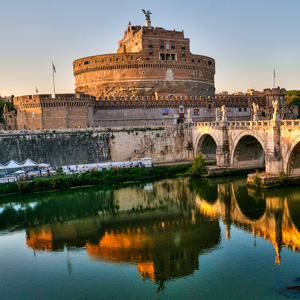
Castel Sant'Angelo ★ - The pope's personal fortress is a giant cylinder of a castle glowering above the Tiber and hiding at its core the ancient tomb of Hadrian and a dozen other ancient Roman emperors.... » more
Santa Cecilia in Trastevere ★ - You'd never know from the bland baroque interior that there are the remains of a Roman house under this church, or that you can slip a modest bribe to the nuns to get inside the cloistered section to see one of Rome's last remaining medieval masterpieces of fresco by Pietro Cavallini... » more
Ancient sites near Termini train station
Museo Nazionale Romano: Palazzo Massimo alle Terme ★★ - The best of the four branches of the Rome National Museum contains excellent statuary plus exquisite ancient Roman mosaics, bronzes, frescoes, coins, and jewelry in a 19th-century villa.... » more
Museo Nazionale Romano: Baths of Diocletian - Installed in the palazzo that was converted out of a portion of the ancient baths complex; intriguing space, but least interesting of the Rome National Museum's four collections.... » more
Museo Nazionale Romano: Aula Ottagona - [currently closed] A single echoing chamber of the Baths of Diocletian complex (but with a completely separate entrance than the collection mentioned above, also part of the Rome National Museum) has been filled with a small but mighty bathhouse art and colossal statuary; amazingly evocative space.... » more
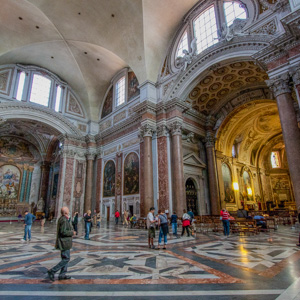
Santa Maria degli Angeli - Michelangelo was commissioned to take a section of the ancient Baths of Diocletian and adapt it to become a church. It's a shame a later architect came along and moved the entrance over to one of the transept arms and spoiled the effect... » more
Ancient sites on the Appian Way & in the South
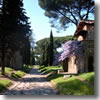
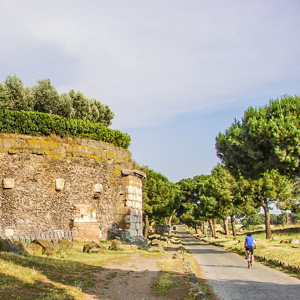
The Ancient Appian Way ★★ - The arrow-straight Via Appia Antica was the first of Rome's great consular roads, running 370km (222 miles) to Brindisi in Apulia, the heel of Italy's boot. Bits of the Ancient Appian Way—there is a semi-parallel modern road called Via Appia Nuova—are covered in tar now to facilitate vehicular traffic. But the original, rutted Roman flagstones still cover long swathes of this mighty ancient road, and it is lined by magnificent ancient tombs and creepy Christian catacombs.... » more
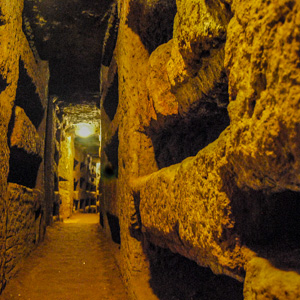
The Catacombs ★★ - These miles of low, dimly lit tunnels carved into the soft tufa honeycomb the earth beneath the Via Appia Antica are wildly popular among tourists. The catacomb tunnels are pigeonholed with tens of thousands of niches where early Christians buried their dead and left some of the world's first Christian art.... » more
The Catacombs of San Callisto ★ - The most crowded, but most impressive of the catacombs...
The Catacombs of San Domitilla ★★ - Small but with intimate tours; a personal favorite... 
The Catacombs of San Sebastiano ★ - The largest, but least rewarding catacombs... 
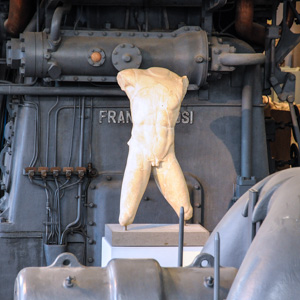
Centrale Montemartini ★ - The Acea Art Center is a bona fide deus ex macchina experience. They've prettied up the old Montemartini power plant to house over 400 gorgeous ancient Roman sculptures from the Capitoline Museums collections that haven't been seen by the public in decades. They’re displayed evocatively against a backdrop of the power plant's inky black iron machinery, much of it so massive and muscularly mechanical that it looks more like a metaphor of early industry than actual working devices, like it came from a Fritz Lang movie set... » more
The Tomb of Cecilia Metella - The best of the Via Appia tombs, the resting place to the daughter-in-law of Crassus, a 1st-century BC land mogul and Julius Caesar's financier, transformed into a midget medieval castle... » more
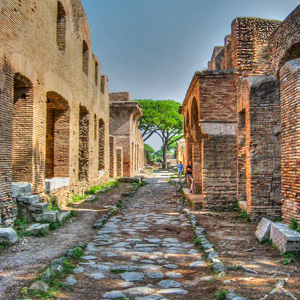
Ostia Antica ★★ - The ghost town ruins of Rome's ancient seaport are like Pompeii without the crowds—and just a 14-mile subway ride west of downtown.... » more
Tips
- Book a tour: If you prefer a private guided tour of Rome's ancient sites, book one via our partner sites Viator.com and Context Travel:
- Ancient Rome tours
• Context: Colosseum and Imperial Rome
• Skip the Line: Ancient Rome and Colosseum Half-Day Walking Tour
• Context: Roma Antica, from the Roman Forum to the Colosseum
• Ancient Rome Half-Day Walking Tour
• Capitoline Museums and Origins of Rome Walking Tour
• Imperial Rome Afternoon Tour
• Context: Caesar and Empire
• Private Tour: Ancient Rome and Colosseum Art History Walking Tour
• Private Tour: Ancient Roman Art History Walking Tour
• Context: Of Cows and Commerce (less visited ancient sights)
• Context: Underground Rome: The Hidden City
• Context: Buried Under Rome (Circo Massimo Mithraeum
• Context: Tours in the Public Interest: Archaeology in Rome (visits otherwise off-limits sights)
• Private Tour: Imperial Rome Art History Walking Tour
• Context: Fall and Rise of Rome
- Ancient Rome: Family tours
• Context: Ancient Rome Discovery
• Context: How Rome Works
• Context: Underground Rome for Families
• Context: Mythology Workshop
• Context: Capitoline Museums for Families
- Ancient Rome: Museum tours
• Context: Capitoline Museums
• Context: The Good Life (Palazzo Massimo) - Ancient Rome tours: Outside the center
• Context: Catacombs Excursion
• Context: Appian Way, Queen of Roads
• Context: Ostia Antica
• Context: Tivoli (Hadrian's Villa)
- Ancient Rome tours
Related pages
- More sights by category: Museums, piazze & fountains, churches, Reid's list, free
- Top sights in Rome
This material was last updated April 2013. All information was accurate at the time.
about | contact | faq
» THE REIDSITALY.COM DIFFERENCE «
Copyright © 2008–2012 by Reid Bramblett. Author: Reid Bramblett