The Official Description
Planning a trip to Europe can be overwhelming, but finally there’s a guidebook that makes it easy.
From the British Isles to southern Italy, the Complete Idiot’s Guide uses an interactive itinerary planner to help readers design the perfect trip.
We’ve put together incredibly extensive trip-planning information that covers all the bases, from buying train passes to checking out the most useful travel sites on the Web.
With foreign-language glossaries, hints on getting around, practical logistical advice, and dozens of accurate, detailed maps, you’ll be an expert before you even step out of the plane.
And once you arrive, we’ve got the lowdown on the top destinations in Europe, complete with our picks of the top things to see and do and the best places to stay and dine.
Honest Feedback
Idiot Guides for Smart Travelers
You’re no idiot, of course. But haven’t you ever felt totally inadequate trying to plan a trip to someplace new or even trying to decide among familiar destinations? The Complete idiot’s travel guides to the rescue. None are in print, selling in bookstores for $15.95 or $16.95 and all promising to be user-friendly, bank-friendly, time-friendly — and fun.
The four newest volumes cover Hawaii, Mexican beach resorts, cruise vacations and Europe; others feature New York City, Walt Disney World and Orlando, San Francisco, and wine country, Las Vegas and New Orleans.
Easier to browse than other equally weighty print travel guides and less choppy than most Web sites, the Complete Idiot’s series is peppered with “signposts” — small boxes filled with special tips under headings such as “Dollars 7 Sense,” “Quick Bites” and “Tourist traps.” Some tips for newcomers are customized in each volume under headings such as “Yo, Gringo” (Mexico), “Ahoy, Mateys” (cruises) and “Malihini Alert” (Hawaii). There are also icons designating kid-friendly deals and attractions. That’s naturally in addition to solid information for novices and veteran travelers alike.
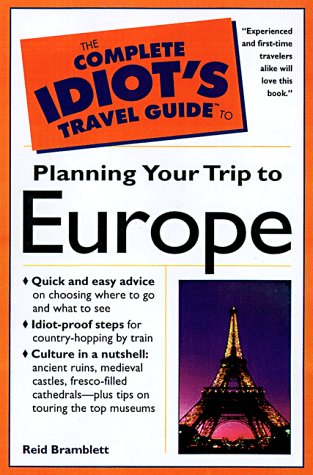
The Complete Idiot’s Guide to Planning Your Trip to Europe is a good example — billed as “the most forgiving travel guide around.” It lets you watch TV to learn about another culture, says the accompanying publicity material. It assures you that it’s OK to pick just one Greek temple and skip the rest, insists you take a siesta break just like the natives and admits that the Leaning Tower of Pisa is overrated (at least now that you can’t climb it while unattractive lead weights are stacked on one side to try to reserve the tilt).
Is the book up to all the self-promotion? I think so. I can even add accolades of my own.
As well as suggested experiences that ‘Kids Will Love” and “Romantic Escapes,” the “Deciding Where to Go and What to See” chapter includes sections with titles such as ’15 Highlight of Europe,” “Some Overlooked Gems,” the “Most overrated” and ‘Disappointing Sights.” These are all tall orders to fill, but the book does a good job.
Some other features — such as best museums, ancient sites, medieval castles and small towns — came as welcome surprises, neatly boxed and with handy references to chapters where you’ll find complete information.
The book covers the basics — getting there, getting around, eating, sleeping — and throughout are those little featured informational blurbs such as “Time-Savers” (including the untrendy admission that a travel agent is still a better source than the Internet when you’re shopping for great fares) and catchy trivia labeled “Bet You Didn’t Know” (such as that opera was born 400 years ago at a theatrical Florentine wedding).
Also helpful are the list of “Itineraries That Work” and suggestions on how many days to allocate for major destinations. Maps? There are dozens, often focusing on a city’s neighborhoods, restaurants or hotels.
The hefty tome (602 pages) from Alpha Books is by Reid Bramblett, author of two other travel guidebooks; it’s $16.95.
The kind of advice I always give my tour participants
If your ego will let you get past the title, the “Complete Idiot’s Travel Guide to Planning Your Trip to Europe” (by Reid Bramblett) is a great overall introduction to European travel.
I have been to Europe nine times, both as a student tour group leader and on my own, and the information in this book is the kind of advice I always give my tour participants. It’s an overview, so you’ll have to look elsewhere for the really detailed information, but if you’ve never been to Europe before (or if you’d like a fresh, realistic and humorous perspective) give it a look.
By far the best guide for seeing the most popular sites
I went to Europe for 2 weeks this summer and took seven guide books with me including Rick Stevens book “Europe Through the Back Door”. By far, the book that I referred to the most was “The Complete Idiots Guide . . .”
Not only did it hit all of the major cities that I wanted to go to (London, Paris, Venice) but it told me important information: tourist traps to avoid, scams that take place, and money and time-saver advice, and the things not to miss.
It is easy to read, and it is the only book that gives you several recommendations for both hotel and restaurants with price guides, phone numbers, and directions.
The other tour books were just to general for me, I needed information on where to stay, where to eat, the currency rates, what to see, and what to avoid. I saved so much money staying in the big cities off the beaten path and not paying tourist prices.
The time-savers where wonderful and I never waited in a single line in Paris for any attraction. For someone who is on a limited budget and limited time and wants to see the things that they have always heard about, this is the book. It is great for college students (me) and for those with quite a larger pocket. It even has some suggested itineraries for those who want to go to Europe but don’t know how to do and see it all.
Very accurate guide…extremely helpful
I used this book when I honeymooned in Europe last year. In Paris (where we spent most of our time), we stayed at one of the hotels the author recommended; we absolutely loved it! He gives places according to price, not always the cheapest place, and you can decide.
The book is big, but it is easy and fun to read and very, very accurate and helpful. I had been to Europe before with the “Let’s Go”, and eventhough you travel on a budget, this book was just too cheap! What I liked about the Idiot’s Guide is that it gives you options.
Cuts to the chase
I didn’t think I needed a guide book to Europe, since we have already been there, but we are visiting Prague in November and I found your section on Prague very good. It just “cuts to the chase”, whereas some other books I’ve read are just too wordy.
Best for families
This book is best for families, especially with children, who want to go to Europe for the first time. The itineraries are great, and there are a lot of useful tips that can save you time and money. The size of it may make the book seem daunting at first, but once you get into it, it’s really very good.
Enough cities and sights to last a lifetime
From London and Paris to Tuscany and Greece, Europe has enough cities and sights to last a lifetime. This guide shows you how to make your trip to Europe manageable and memorable.
Favorite bits
Understanding European Hotels
Note: Since this series is designed for absolutely everyone, one of the fun parts of writing this book was to try to put myself in the shoes of someone who has never traveled in their lives—certainly not abroad—and consider all the questions they may ask, misconceptions they might have, and cultural norms they never really thought about yet may differ in other countries.
In the dining section, this meant remembering to inform readers that—unlike in American restaurants—water does not come automatically to the table, you have to specify sparkling or still, it’ll come in a bottle, you have to pay for it (unless you ask for tap water), and ice is a pretty foreign concept.
With that in mind, here is the start of Chapter 7, which all about European lodgings.
In an era when round-trip plane tickets cost as little as $300, including taxes, but you’re lucky to find a hotel room for under $100 per night (what with the weak dollar/strong Euro phenomenon), accommodations will probably eat up the biggest slice in your travel budget.
But because you usually have so many options of where to stay, lodging is also an area in which you can save a lot of money. In Paris, for example, you can spend several hundred dollars on a lavish palace, stay in a clean but simple two-star hotel down the street for around $60, or check into a hostel for just $26 per person per night.
Understanding European Hotels
Hotels in Europe tend to have fewer frills and features than hotels in America. For example, free cable television is standard at even the cheapest American motel chains. In Europe, however, few moderately priced and inexpensive hotel rooms even have televisions.
Europe’s more traditional hotels and pensions (smaller, family-run places) typically differ from American hotels in the following ways:
The appearance of the lobby rarely reflects the appearance of the rooms. Never judge a European hotel by the front entry; expensive hotels sometimes invest heavily in the lobby but cut corners on the rooms, and cheaper hotels often have just a dingy desk in a hallway, but spotless, fine accommodations upstairs.
- The appearance of the lobby rarely reflects the appearance of the rooms. Never judge a European hotel by the front entry; expensive hotels sometimes invest heavily in the lobby but cut corners on the rooms, and cheaper hotels often have just a dingy desk in a hallway, but spotless, fine accommodations upstairs.
- “Double” beds are often two side-by-side twin beds made with a single sheet and blanket (or overlapping twin sheets). If you’re worried about that crack between the two widening over the course of the night and your slipping through (it happens), turn the mattresses perpendicular to the springs. Also, watch out for ancient mattresses that sag in the middle.
- Hotels in old European buildings often don’t have elevators. If they do, the few elevators that are available are likely to be so rickety and slow that they belong in a museum.
- Floors are often covered with tile or linoleum instead of carpet.
- Bathrooms are vastly and surprisingly different from the American norm (see the next section, “The bathroom: The big culture shock”).
- You can trust hotel staff to provide you with general information and pamphlets about sightseeing and attractions, but be wary of anything beyond that. A restaurant recommended by an employee may be one owned by a relative or someone who has agreed to give the hotel a kickback. Usually the place is fine, but never count on a hotel to direct you to the best food in town. Hotel staff members may also offer to get you tickets for the theater or cultural shows, but tickets are usually cheaper from the box office or local tourism office.
In short, think of the hotel simply as safe, clean, place that’s reasonably close to the sights, with a room where you can rest your body between long days of sightseeing.
Oh, and unless you’re in a three- to five-star property, don’t expect to see chocolates on your pillow or little bottles of shampoo and conditioner in the bathroom, either.
The bathroom: The big culture shock
People who haven’t traveled in Europe think that language, architecture, and food best illustrate the cultural differences between America and the Continent. Sorry, guess again. Americans traveling in Europe experience the greatest culture shock in the bathroom. It all starts in your first cheap pension, when you find out that the only bathroom is down the hall and shared by everyone on the floor—of both sexes.
European hoteliers have trouble understanding why so many American travelers don’t want to share a bathroom. Although more and more European hotels are installing bathrooms in every room, this is far from the norm. If you simply can’t bear the thought of sharing a bathroom, you’ll have to pay extra for a private bathroom in your room.
Europeans usually refer to the bathroom itself simply as the toilet. You may also hear the term W.C. (short for the British euphemism “water closet”).
See the section on electricity in Chapter 10 for information on what is not safe to plug into European bathroom outlets. (Here’s a hint: everything.)
The shower: Another new adventure
In many European hotels, the concept of a shower is something like this: A nozzle stuck in the bathroom wall and a drain in the floor; curtains optional. In some cramped private baths, you have to remove the toilet paper from the bathroom to keep it dry while you drench the whole room with your shower.
Bath-takers are not home-free, either. Some European hotels still have half-tubs, in which you can only sit, not stretch out. The half-tub usually sports a shower nozzle that has nowhere to hang—so while your knees get very clean, the floor gets very wet.
Although this has been changing in recent years, in smaller, cheaper hotels it’s still sometimes true that hot water may be available only once a day—and not when you want it. This is especially true in hotels with shared baths. Because heating water is costly, many smaller hotels only do it once a day, in the morning; after the hot water is used up, you won’t be able to get any more until the next day. So when you check in, ask “When is the water hot?” Try to be the first in line, shower quickly, and soap up with the water off. In some countries, especially Britain, you may have to turn on the hot water yourself at a small hot water heater either inside or just outside the stall.
Before you take your shower or bath, remember that traditional European towels are annoyingly nonabsorbent. Carry your own towel for just such an emergency (a terry-cloth hand towel is less bulky than a full-sized one; camping towels work great).
That extra thing: Not a toilet
The extra porcelain fixture that looks like another toilet is called a bidet (bi-day). Do not use the bidet as a toilet. The water that jets up and out is supposed to clean your private parts more thoroughly than toilet paper.
Some non-European travelers wash clothes or store fruit or beverages in the bidet, but if you think about what the bidet is supposed to be used for, you’ll see the sink is a much better place to do your laundry.
Amsterdam intro
Considering the ages of all the great European cities, Amsterdam is rather young. Founded in 1200 as a fishing village at the mouth of the Amstel River, the city rapidly grew into the western world’s trading powerhouse.
The 17th century ushered in the Dutch Golden Age, marked by a vast trade network and the American colony of Nieuw Amsterdam (later New York), that filled its coffers while painters such as Rembrandt colored its cultural life.
Elegant, 17th-century row houses that often look impossibly tall and skinny line the canals of Amsterdam, a city of 7,000 gables. For many years, property was taxed on the width of the frontage, so people built their houses as narrowly as possible. To get maximum square footage out of such skinny property, Amsterdammers extended their structures high and deep.
Following a bout with strict Protestant laws, Amsterdam became an exceedingly tolerant city within a continent of prejudice. This made it attractive to religious and other dissidents from Europe, such as the Jews and the English Puritan Pilgrims, a stuffy, devoted bunch that eventually sailed from here to Massachusetts. Wealthy, 17th-century Amsterdam dug a slew of new canals, built stacks of town houses, and welcomed the artists with its beckoning atmosphere of tolerance and cultural interest.
The traditions of encouraging high art and tolerance while discouraging prudish morality laws have endowed the city with some of its greatest attractions.
Amsterdam has some of the world’s most famous museums; besides Rembrandt, the Dutch arts claim native masters such as Frans Hals, Jan Vermeer, Jan Steen, Vincent van Gogh, and Piet Mondrian. Its cityscape is one of the most beautiful and cohesive anywhere, with 250-year-old town houses lining well-planned and scrupulously manicured canals.
The Dutch leniency toward drugs and prostitution has grown into a huge tourism industry that lures students and other hip, mellow types to the city’s “smoking coffeehouses” and visitors of all stripes who giggle and gawk at the legal brothels in the (in)famous Red Light District. In 2004, some Dutch legislators introduced a bill banning all marijuana use. Given the Netherlands’ history of tolerance, it’s unlikely to pass — though EU pressures to conform to continent-wide standards may change all this.
Nazi occupation during World War II threw the bright light of Dutch tolerance into sharp, shadowed relief with its anti-Semitism. Despite the best efforts of many locals, thousands of Amsterdam Jews were seized and deported. Among them was Anne Frank, a teenager whose hiding place still stands and whose diary remains one of the most powerful and enduring pieces of Holocaust literature.
No other city has such an eclectic mix of sights, from the basest of pleasures to the most somber reflections on human cruelty. Spanning from the Renaissance to the modern period, the Dutch presence and strength in the fine arts is an obvious tourist draw.
Visitors also come to shop for diamonds, to drink Amsterdam beers such as Heineken and Amstel in brown cafes (so-called because the best of them are stained brown from decades, if not centuries, of smoke), or to go see the tulip fields and the windmills.
To really appreciate Amsterdam, you should plan on spending at least two full days there — for many, the museums alone will take at least that long.