The Official Description
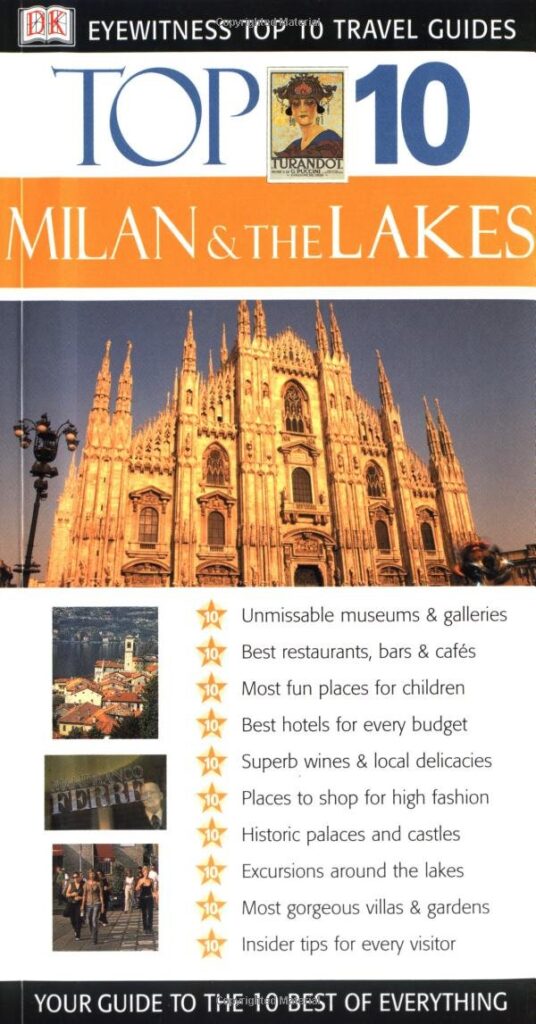
DK Eyewitness Travel Guide: Top 10 Milan and the Lakes will lead you straight to the very best the region has to offer. Whether you’re looking for the things not to miss at the Top 10 sights or want to find the best nightspots, this guide is the perfect pocket-sized companion.
Rely on dozens of Top 10 lists from the Top 10 museums to the Top 10 events and festivals. There’s even a list of the Top 10 things to avoid. The guide is divided by area with restaurant reviews for each, as well as recommendations for hotels, bars, and places to shop. You’ll find the insider knowledge every visitor needs to effortlessly explore every corner of the region with DK Eyewitness Travel Guide: Top 10 Milan and the Lakes and its free pull-out map.
DK Eyewitness Travel Guide: Top 10 Milan & the Lakes: showing you what others only tell you.
Honest Feedback
Note of appreciation from a Milanese
I usually buy these guides when I travel for my pleasure, so it seemed a good idea to buy this one when I had American friends visiting, and I wanted to introduce them my city in a thorough, well-informed way. And it was a really good idea indeed! This volume is consistent with the other ones in the series: the Eyewitness may not be as updated or insightful as the Frommer about hotels or restaurants (though I found the Milan listings generally good), but it’s virtually unbeatable when it comes to find your way around a city. The many maps and, above all, the amazingly detailed 3-D drawings with the itineraries are entertaining and real time-savers: thanks to the visual approach you don’t waste a lot of time trying to understand if the old building you’re looking at is actually the one you were looking for! As a native , I found the big “X-rays” pictures of the “big attractions” ( the Galleria, the La Scala Opera, the Castle, the Duomo Cathedral) especially well done, but I also could find at least a couple of off-the-beaten-path attractions I didn’ t know ! As ever, the guide also provides an informative presentation of the social and historical background of the city. Finally the “practical life” section (money , transportation, aiports) is extremely well done and clear. We also used the guide for a trip to Lake Como and Bellagio (astonishingly, I had never been there before!) and the whole thing was smooth and exhaustive. The texts are, as ever, somewhat succint but not too simplistic : they tell you more or less what you need to know, and the (unavoidable) inaccuracies are few. The guide is also satisfactorily updated, even if it misses some of the latest renovations, like the new huge Deco-ish fountain of the Castle and the new La Scala Square, now beautifully restored to its turn-of the century appearance, but these guides are regularly updated, and the next edition will surely have them. Finally, my friends’ visit was a success, and I know much more about my city, too. Also used (and recommended) : Rome, London, Berlin, Barcelona NYC, San Francisco, Florida.
This is the state-of-the-art tourism book
After dozens of titles edited during the last years, Eyewitness really did it! I used to live in Milan and it’s a great place to spend some days, along with the lakes. The coverage of the main lakes (Como, Lugano, Garda) is amazing!
So much for so little – this guide is great!
We’ve just returned from a trip to Milan, Lake Como and Bergamo. This book proved invaluable, not just for information on the places, but also for tips and recommendations. The map in the back is a great idea.
This book is great
It divided Milan into smaller sections so it’s easy to figure out where everything is located. It’s rare to find so many pictures that are as big and clear as they are in this book. There’s also a street finder map in the back, which is very helpful. It really helped me prepare for my upcoming study abroad trip to Milan.
Great useful guide
Used this while in the Lakes a few years ago. Very nice looking guide with useful information. Worth the purchase. Whenever I was reading others would want to borrow straight after, jealous they didn’t think of getting one. Used in Como, smaller lakes and Milan.
DK TOP 10 Milan and the Lakes
Used for 4 days in Milan, 5 days car hire to Lake Garda. This is a big area to cover. The ‘Top Ten’ format is ideal to quickly sift through the offerings then make your own mind up so you feel nothing important has been missed. Quality paper, laminated pull out maps,very readable, excellent photos lots of advice and snippets. More handbag than pocket. Ideal if pressed for time or on a fortnight tour. Space limits advice on establishments to eat or stay. I like DK and this is one of their best.
My favorite travel guides
The Top 10 travel guides are my favorites for when we travel, which is a lot. The books contain all the essentials in a concise format and the books are small enough to fit in a purse or coat pocket. The maps are excellent, particularly the small removable map in the back pocket.
This guide book was a great help
We are just back from long weekend in Milano, this guide book was a great help. Maps, timetables, prices all updated. It is a light, pocket / small bag size guide, no trouble to keep it on you all the time.
Best Series Ever!
For those who prefer to stay “old school” and prefer a guide book to read and digest before travelling to a new place, the DK Eyewitness Guides are invaluable. The maps are usually spot on and the recommendations of what to see and where to eat, although limited by space, are usually good. Am a big fan of this series, especially the ones covering Italy.
Visiting Lombardy Region
This guide took me back to my old stomping grounds before boarding the plane that took me there. Pictures show it all!
I give them to all my clients
Love the Top 10 Books. I give them to all my clients.
Favorite bits
Here are a few samples of text section from the guide—sorry, no photos as I do not have those rights (which is a shame, since there are a TON of photographs in these Top 10 guides).
Please keep in mind that that last edition of this book was written in 2013, so not everything excerpted below is necessarily accurate today. As in all things, travel advice changes.
The Smaller Lakes & Cities
The Smaller Lakes & Cities
There is little unifying this motley assortment of smaller lakes and cities other than a noticeably smaller percentage of the tourists which throng Milan’s great sights and back up traffic for hours along the Big Three lakes. The museums may not be as important as Milan’s, the villas less grand than Como’s, but a few days spent here off the beaten path can offer a rewarding break from the crowds.
1. Lake Orta
The region’s westernmost lake lies in Piemonte. Its main town of Orta S. Giulio bans cars from the cobbled medieval center. It sits at the tip of a wooded promontory which was turned into a Sacro Monte, a path lined by 20 decorated chapels, between 1591 and 1770. Boats head to the postcard Isola S. Giulio, home to a basilica founded by San Giulio himself after he sailed here on his miraculously stiffened cloak and drove out the infestation of serpents à la St. Patrick. He appears inside carved in dark stone twice: leaning on his sword between Evangelists on the wonderful Romanesque pulpit, and battling mythological beats on a wall relief. The frescoes on the right aisle are 14th and 16th century.
At the north end of the lake, Omegna is the unlikely epicenter of Italian industrial design, where local craft factories founded at the turn of the 20th century developed into the modern giants of housewares: Alessi, Calderoni, Lagostina, and Bialetti. In the industrial suburbs there’s a Forum Museum (www.forumomegna.org; adm) of this modern utilitarian art form, including designs by Richard Sapper, Philippe Starck, and Robert Graves.
Tourist info: Via Panoramica in Orta S. Giulio * 0322-905-163 * www.distrettolaghi.it
2. Lake Iseo
Though less important than Orta, Iseo is probably the prettiest of the smaller lakes, a far less spoilt-by-development cousin to the Big Three. Most of the worthwhile sights and towns line the eastern shore (the views spoiled a bit by the vast quarry on the western banks).
Iseo itself is a fine little town, and the most touristy with modest hotel complexes and watersports facilities, but offer little to see. Head north to Lovere and the Galleria Taldini (open Apr-Oct; adm) with paintings by Jacopo Bellini, Parmigianino, Tintoretto, Palma Il Giovane, Tiepolo, and Hayez.
Santa Maria della Neve church on the edge of Pisogne is slathered inside with excellent 1532-34 frescoes by Romanino (follow his name on signs; if locked, inquire at the cafe inside the adjacent cloisters). Above the lake, outside the town of Zone, is a series of much-photographed, weirdly eroded rock pinnacles worth the detour.
The lake itself is dominated by a huge forested hump at its center, Monte Isola, the largest lake island in Italy. There’s little in particular to see, just a relaxing pace of life in its half-dozen tiny villages accessible by ferry from Sulzano or Sale Marasino.
North of Iseo stretches the Val Camonica, full of prehistoric rock carvings (see ppxx).
Tourist info: Lungolago Marconi 2, Iseo * 030-980-209 * www.bresciaholiday.com
3. Lake Varese
The Varesotto is actually a quartet of little lakes (Varese, Monate, Comábbio, and pond-sized Biandronno), popular amongst 18th century Lombard landscape painters for their bucolic settings, quiet hamlets, simple Romanesque churches, mirror-like waters, and Alpine backdrops. A few factories notwithstanding, the scene is largely unchanged today, unplagued by tourist resorts or excessive development.
The roads rarely touch the lake shores, forcing you to navigate into the villages to actually glimpse the waters. This marshy region has yielded some important prehistoric finds, most especially on Lake Varese’s Isolino islet (catch a boat from Biandronno June to September), though the actual finds and the literature contextualising it all are kept in the Villa Mirabello’s musei civici in the nearby city of Varese.
Tourist info: Via C. Carrobbio 2, Varese * 0332-283-604 * www.hcs.it/varese
4. Lake Lugano
Lugano is one of those wonderful natural formations that underscores the arbitrariness of political boundaries, snaking from Italy through Switzerland and back into Italy again. In fact, its main attraction, the resort Campione d’Italia, is an Italian enclave set firmly within Switzerland’s boundaries, a slightly raucous island of pizza restaurants and gambling casinos interrupting the more staid Swiss shoreline.
The (Swiss) capital of Lugano is missable, but to its south, outside Melide in the tight southerly bend of the lake, is the delightfully kitsch Swiss Miniatur (www.swissminiatur.ch; adm), one of those contrived holiday-spot sights that nonetheless manages somehow to be intriguing: a vaguely accurate “map” of Switzerland with all its major monuments (cathedrals, castles, lakes) reproduced at 1/25 size.
Tourist info: Campione d’Italia * Via Volta 3 * +41-91-649-5051 * www.campioneitalia.com
5. Lake Idro
A slip of a lake (not quite 10k long, and a mere 2k wide) just west of Garda, renowned for its trout, sailing and windsurfing, sheer beauty, and fine skiing in the surrounding mountains. The town of Anfo sports a 16th century castle; Sant’Antonio’s church has 15th century frescoes.
6. Bergamo
A vibrant city of medieval streets, fashionable boutiques, and Renaissance churches, Bergamo is one of the Top 10 of the region, covered fully on ppxx-ppxx.
7. Mantova
The palaces, churches, and artworks by Mantegna and Giulio Romano help make Mantova, too, one of the entire region’s Top 10, covered fully on ppxx-ppxx.
8. Cremona
Cremona is the city of lutari, some of the world’s best makers of hand-crafted string instruments, which reached its pinnacle in the 17th century at the workshop of Antonio Stradivari, the best violin-maker there ever was. Aside from a pink marble Duomo of the 12th century (sprouting Italy’s tallest bell tower and covered in 16th century frescoes), Cremona’s top sights are fiddle-oriented. The Raccolta dei Violini is a room of several exquisite 17th and 18th century instrument tucked away in the Gothic Palazzo del Commune. The Museo Stradivariano displays an embarrassment of precious stringed instruments by the big names (Amati, Stradivarius, Guaneri) plus primers on the lutist’s craft and an interesting video.
Tourist info: Piazza del Comune 5 * 0372-23-233 * www.cremonaturismo.com
9. Brescia
Relentlessly industrialised Brescia hides a fine medieval/Renaissance center with several mementos of its time as a Roman colony (an AD 73 temple called the Capitolino and a Roman Theatre, both bang in the centre of town on Via dei Musei), a pair of cathedrals (give the baroque/Neoclassical Duomo Nuovo a miss, but stop by the rotund Romanesque Duomo Vecchio), and many lovely piazzas and palazzi. Installed in the ancient San Salvatore e Santa Giulia Monastery, where Charlemagne’s ex-wife died, is the excellent Museo della Città (adm), a repository of prehistoric, Roman, and medieval objects and artworks. The worthy painting gallery, Pinacoteca Tosio-Matinengo (adm), sports works by locals Foppa and Moretto as well as Raphael and Tintoretto.
Tourist info: Corso Zanardelli 38 * 030-43-418 * www.bresciaholiday.com
10. Sabbioneta
Duke Vespasiano Gonzaga had this entire town custom-built in the late 16th century, the closest any potentate ever got to fully realizing the ideal Renaissance city. he purposefully didn’t hire famous architects—that way, he’d get all the credit for the designs.
There’s a single admission ticket to its major sights that includes a free guided tour in Italian (about 1:15 hrs). Off the Palazzo del Giardino (summer palace) opens the fabulous, 96 metre-long Galleria, frescoed with trompe-l’oeil and lined with ancient busts (the few not carried off in later years to Mantova). The fascinating Teatro all’Antica was the first free-standing, purpose-built theatre since antiquity, designed by Vicenzo Scamozzi in 1588-90 and rife with symbolism the guide will explain. For more, see ppxx.
Tourist info: Piazza d’Armi 1 * 0375-221-044 * www.unh.net/Sabbioneta/index.html or www.sabbioneta.it
Itinerary: Two days from Garda to Como
The smaller lakes and towns are scattered across Lombardy and eastern Piemonte, impossible to see in one short trip, but some of the best can been enjoyed on a leisurely two-day drive from Lake Garda to Lake Como.
Head west on the A4 Autostrada to Brescia to spend your first morning admiring its museum and Roman sights. After lunch at Due Stelle, continue to nearby Lake Iseo. Explore the eastern shore, pausing to see the Romanino frescoes in Pisogne, the small museum in Lovere, and the weird rock pinnacles outside of Zone. Have dinner at I Due Roccoli high above the lake, and spend the night.
On Day Two, drive north into the Val Calmonica to hike the hillsides full of prehistoric rock carvings, then head back south to diverge west at Lovere for the back road to Bergamo. Check into your hotel and spend the afternoon enjoying the Renaissance architecture and carvings of the Colleoni Chapel, the medieval town square, the bustling main drag lined with shops, cafes, and wine bars, and the excellent Accademia Carrara painting gallery. End your day with a hearty meal at the aptly named Antica Hosteria del Vino Buono (the “Ancient Inn of Good Wine).
Listing: Shopping, Cafes & Nightlife
1. Lagostina, Crusinallo-Omegna, Lake Orta
The discount factory outlet for the famed homewares designer. Get 30-50% off here and at similar outlets on the same road—Bialetti (no. 106) and Fratelli Piazza Effepi (no. 242)—and Alessi (Via privata Alessi). Ask for slight irregulars for bigger savings.
Via IV Novembre 39
2. Calzaturificio di Varese, Varese
Stock shop and discount outlet for brand name footwear, from trainers to heels, Sisley to Benetton, with a new influx daily
Via S. Martino 5
3. Vineria Cozzi, Bergamo
This old-fashioned wine bar retains its glass cases and marble cutting board in the front section, a more private back room through the doorway, and a pretty little plant-filled courtyard off to one side into which just a handful of tables can squeeze. Perform your own wine taste-testing accompanied by salumi, quiches, or light dishes.
See ppxx.
4. Caffè del Tasso, Bergamo
This historic caffè on the main piazza has been a local living room (and sit eof rebellious debates) since the 16th century.
Piazza Vecchia 3 * E
5. Papageno Pub, Bergamo
Little round tables and Guinness on tap just a few steps off the main square with windows open onto the pedestrian parade on Bergamo’s main drag.
Via Colleoni 1b
6. Lubiam, Mantova
Since 1911, one of Italy’s top tailors of men’s suits. This warehouse holds staggering array of choices (over 1,000 suits, 1,500 jackets, etc.) at 35% off.
Viale Fiume 55
7. Oblò, Mantova
Popular pub with ultra-friendly proprietors, good beers, great panini, a non-smoking room, and a loyal local clientele. The music is loud, but it’s not a raucous place.
Via Arrivabene 50
8. Sperlari, Cremona
Wood-floored, be-columne3d shop from 1836 selling its own candies, torrone (nougat), cordials, liqueurs, mostards (candied fruits), and “cherries with spirit” (or rather spirits—pickled in alcohol).
Via Solferino 25
9. Concerts and Opera at Teatro Ponchielli, Cremona
Fancy hearing a string quartet composed entirely of Stradivarius instruments? Cremona’s about the only place in the world where this happens regularly. Its unique musical heritage draws the best musicians from around the world for performances.
Corso V. Emanuele 52 * www.rccr.cremona.it/doc_comu/tea
10. I Portici del Comune, Cremona
Good coffee, gelato, and panini with tables ranged under an arcades across the piazza from the prettiest Duomo façade in Lombardy.
Piazza del Comune 2 * E
Listing: Where to Eat
1. I Due Roccoli, Iseo, Lake Iseo
High above the town of Iseo, set in a private park, the restaurant at this excellent hotel (see ppxx) snuggles into a stone-walled patio overlooking the woods-fringed lawns and serves refined regional food. See ppxx. [***ED: FIRST CROSS-REF IS TO STREETSMART AND THE HOTEL BIT; SECOND CROSS-REF IS TO THE “BEST RESTAURANTS’ IN THE “BY SUBJECT” SECTION]
Via Silvio Bonomelli * 030-982-2977 * www.dueroccoli.com * EEEE
2. Da Candida, Campione d’Italia, Lake Lugano
Elegant restaurant mixing French and Italian cuisine, famed for its homemade fois gras and the polenta slow-cooked over the dining room’s open fireplace.
Via Marco 4 * +41-(0)91-649-7541 * Closed Mon and lunch Tues * EEEE
3. Antica Agnello, Lake Orta
This cosy taverna serves lake fish, local game, and funky regional dishes not often sampled at restaurants in larger town. Always the freshest ingredients.
Via Olina 18 * 0322-90-259 * Closed Tues * EE-EEE
4. Villa Crespi, Lake Orta
Stylish restaurant in the unique Moorish-fantasy hotel (see ppxx), with dining on the colonnaded verandah overlooking the gardens, elegant service, and refined regional cuisine.
Via Fava 8-10 * 0322-911-902 * www.lagodortahotels.com * EEEE
5. Antica Hosteria del Vino Buono, Bergamo
Hearty bergamasco fare and several good menu desgusatazioni (tasting menus) in the simple rooms of a wedge-shaped medieval palazzo near the upper towns’ funicular stop.
Via Donizetti 25 * 035-247-993 * Closed Mon * EE
6. Taverna del Colleoni & del Angelo, Bergamo
Rambling formal restaurant installed in an evocative Renaissance palazzo on the main piazza, with outdoor dining in summer. Turn to the back of the menu for their traditional specialties.
Piazza Vecchia 7 * 035-232-596 * Closed Mon * EEEEE
7. Leoncino Rosso, Mantova
A rustic restaurant just off the main square that’s been serving up scrumptious mantovana specialties since 1750. Don’t miss the local favourite tortelli di zucca (pasta stuffed with pumpkin).
Via Giustiziati 33 * 0376-323-277 * Closed Sun * EE
8. Ochina Bianca, Mantova
Distinctive variations on local specialties, judicious use of lake fish, in an elegantly simply atmosphere.
Via Finzi 2 * 0376-323-700 * Closed Mon-Tues * EE
9. La Sosta, Cremona
A wood-paneled osteria a block from the Duomo and beloved by locals for its home cooking. The gnocchi vecchia Cremona (honey roasted potato dumplings stuffed with salami) is a 17th century recipe.
Via Sicardo 9 * 0372-456-656 * Closed Mon and dinner Sun * EEE
10. Due Stelle, Brescia
Satisfying local foodies for over a century in a fireplace-warmed ancient interior or around a 16th century fountain in the courtyard.
Via S. Francesco 48 * 030-42-370 * Closed Mon and dinner Sun-Wed * EE-EEE
Things to Avoid
1. Milan in August
August in Milan is often brutally hot, and almost the whole city goes on vacation. In fact, Milan has one of the highest rates of fines charged to crucial businesses (chemists, grocers) that are scheduled to stay open but whose owners illegally shutter the shop to take a week at the beach. The only bit of town open for business is the Navigli and its glut of restaurants and bars, but fair warning: bring plenty of insect repellant.
2. The lakes in winter
Most hotels shut down from October or November through February, most reopening only at Easter. Only Lake Maggiore keeps a longer season, with many of its inns and restaurants closing only for December or January.
3. Not booking a Milan hotel during trade fairs
The usual tourist seasons doesn’t apply to business-oriented Milan. The months to watch out for here are March, April, and October when major trade fairs and fashion shows keep even the most basic, one-star hotels booked solid. Even outside these months, it can be difficult to find a room. Milan is one city where it’s always wise to book ahead.
4. Wearing waist packs
These are the worst travel accessory ever invented. Terribly convenient, yes, but nothing has pleased the world’s pickpockets more than the popularity of these pouches. They place all of your important belongings discreetly below eye-level, at the perfect height for a light-fingered thief to rifle through at his leisure.
5. Driving in Milan
A car is utterly unnecessary in Milan: some roads in its historic center are now pedestrianized; where sights are accessible by car, parking is scarce; when it is available, parking is preposterously expensive; and to the uninitiated, Italians seem to drive like maniacs on speed. Save renting a car for the end of your Milan stay to get out of town and tool around the lakes.
6. Full-pension hotel rates
Hotels on the lakes often cater largely to habitual holidaymakers who stay a week or more and rarely budge from their chosen tanning spots. The package deals they try to force on clients reflects this; some require stays of three nights, many insist you take at least a half-board deal. With few exceptions, their in-house restaurants are disappointing. Try to get out of the requirement if possible; if not, settle for half-board so you can take at least one meal a day in a proper restaurant or lovely lakeside trattoria.
7. Not reserving Last Supper tickets
If you do not book ahead to visit Leonardo’s Last Supper, you will almost surely get turned away at the door. The limited number of visitors and immense numbers of escorted tour groups buying up blocks of tickets almost guarantee it. Try to reserve at least two days in advance. This is not an exaggeration.
8. Gardaland
Yes, this theme park is recommended under the “For Children” section, and it is Italy’s best theme park–but that’s not saying much. It’s a decent diversion if the kids are overloaded on art and/or bored with those romantic lake vistas, but frankly EuroDisney does it better. Though one of Garda’s largest individual “sights,” it is not worthwhile in and of itself unless you have the aforementioned bored kiddies in tow or are seriously into kitsch.
9. Off-the-rack prices
Window shopping amid the renowned boutiques of Milan’s quadrilatero d’oro can be fun, but few have the pocketbooks to turn browsing into a new wardrobe–nor should you. Luckily, this epicenter of high fashion has also spawned a thriving business of spacci (stock houses) where you can get last year’s fashions, slight irregulars, odd sizes, at 30% to 50% off the price tags dangling from sleeves in the boutiques. Sometimes you even come across a “used” dress that was worn precisely once: by a supermodel on a Milan runway.
10. Overloading your Itinerary
Though Milan doesn’t invite lingering and you probably should plan your museums and monuments back-to-back, once you get up to the lakes, it is time to decompress. The point of a lakeside vacation is to sit still and enjoy the Italian art of dolce far niente, the “sweetness of doing nothing.” Several days in Bellagio with a few lazy boat day-trips will be far more rewarding than trying to circumnavigate Lake Como from town to town. Besides, quite frankly, you’ll probably be disappointed if you treat the lakes as primarily a sightseeing destination: their modest churches with scraps of fresco, small castles, manicured gardens, and grandiose villas are diverting, but with a few exceptions they don’t stand up as sights to go out of your way for, merely ones to enjoy if you’re already there.