The Official Description
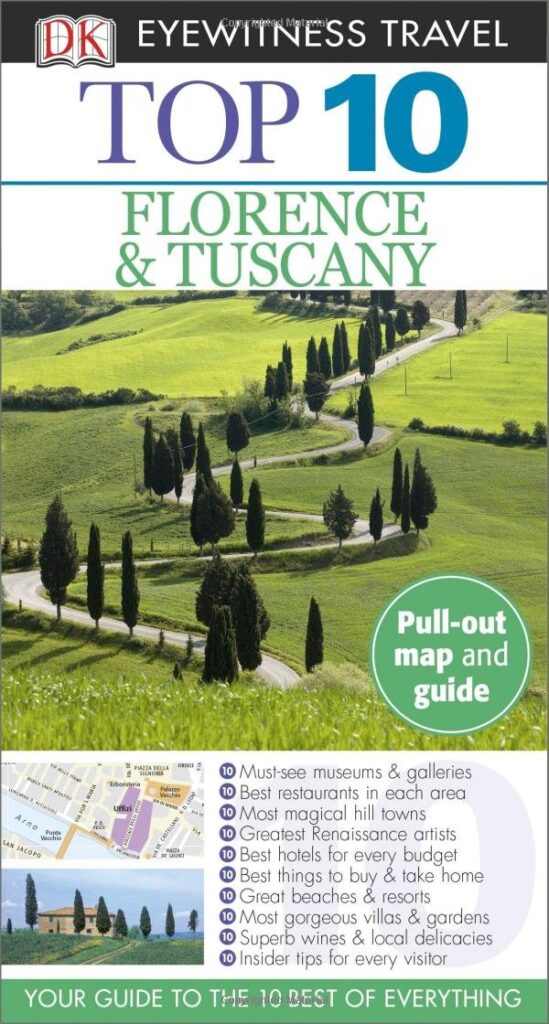
Discover the rich culture, world-renowned attractions, and storybook scenery of Florence and Tuscany with DK Eyewitness Travel’s Top 10 Florence and Tuscany travel guide.
The unique Top 10 format of this guidebook highlights the main attractions you won’t want to miss from the medieval hill towns and fine vineyards that lay atop Tuscan lands to the artistic masterpieces that fill the museums of Florence.
Exclusive insider tips take you to the best places Florence and Tuscany have to offer and succinct descriptions reveal just what you need to know to get the most out of your visit. Learn the history behind the art and architecture of the Duomo Group, from Brunelleschi’s elegant dome to Ghiberti’s gilded bronze “Gates of Paradise.” Immerse yourself in the depth of Renaissance culture, the must-see artworks of museums and palaces, and flavors of varied Italian cuisines.
Let the lists guide you to the top 10 places to dine; the top 10 vineyards, villas, gardens, and churches to visit; and the top 10 spas and resorts for relaxing along Italy’s azure coast.
DK Eyewitness Travel Guide: Top 10 Florence and Tuscany includes useful words and phrases, tips on staying within your budget, a pull-out map that depicts main sights, and more. With dozens of Top 10 lists and more than 60 great ways to
Honest Feedback
LOVE IT! Perfect size – essential information to take with you on a trip
Buongiorno! I recommend all the Eyewitness Travel guide books to anyone who is planning a trip to Italy. I give this book as a freebie to all my clients who sign up for the tours of Tuscany that I lead each year. They can take it with them to all the day trips – it’s light, without compromising the quality of images and useful information on the most beautiful stops in Tuscany.
Being from Italy (Florence to be exact), I was surprised to see how accurate and easy to find the information was, while at the same time, keeping it concise and essential.
If you’d like a more thorough book on all of Italy, I recommend the “Italy” guidebook, which is also by DK Eyewitness travel. However this last one is not light, and you may have to leave it home before going on your trip. Full of useful information.
# 1 in my book!
We just returned from a trip to Italy. We used this easy to follow guide to see the best of Florence, Siena, Montalcino, and Montepulciano in four days. Excellent for planning to see the sights,shop, and eat! Small enough to carry in a handbag so it was always accessible.
Great book!
Great book to have at an affordable price that makes it easier to locate and know where you are going and for planning purposes. We utilized each day we were there.
Helpful and compact
This guide hits the sweet spot. It is to the point and reliable. I recently used it. Although I know Florence quite well, I thought the lists of Top Ten items were very helpful in planning a short trip.
This is a must for the area
It is small and compact and VERY complete for our tours of Florence, Pisa and the Tuscany area.
Wonderful book
We used this one exclusively for seeing the sights all over Tuscany
Excellent guide!
Petit , bien illustré , facile d’utilisation, l’essentiel y est expliqué; j’adore cette collection TOP 10 !
Perfect for short vacations or business trips
The unique Eyewitness Top 10 Travel Guides feature an easy-to-use format that focuses on the absolute best sights, restaurants, shops, and hotels in each destination city. Pages of top 10 lists, each supplemented with plenty of description and detail, steer travelers to the top attractions in Venice, Paris, London, and many more exciting cities around the world.
These pocket-sized guides are also perfect for short vacations or business trips. A special feature of DK’s travel guides is the stunning three-dimensional views and cutaway models of significant landmarks. Balancing an elegant format with comprehensive information, DK’s guidebooks are both practical resources and great souvenirs of your trip.
Excellent
Lots of good info to guide you on what to see, but small enough to carry around!
Great for on-the-go
My wife and I love the Top 10 series. We always buy a Frommers or Rick Steves book for the trip’s planning, but the Top 10 is a must for the trip itself. It’ll fit in a pocket (a long one), and will provide quick and easy references to the most important sights, as well as maps and public transportation routes.
The quality of the book is second to none
We were on a cruise ship and only had one day for a tour of Florence thus we opted for the Top Ten from DK Eyewitness. This is just what we needed as we were able to take in far more site by knowing where we should go and how to get there. Too many shore tours are wrapped up in dealing with the masses and getting the group to a sales presentation.
Go on your on with this travel guide and you’ll see a lot more in a short period of time. The quality of the book is second to none and the information in the book is very complete. Purchase at a discount as they are everywhere.
Good guide to carry with you
I have purchased several other the Eyewitness Top 10 Travel Guides, and have been quite pleased with the content given the small size of the book. I do not use or recommend the Top 10 books as a sole planning guide for an extended visit to an area, but rely on them for their portability.
Before this week-long visit to Florence, I checked out a variety of travel guides from my local library to help plan my visit, visited numerous web sites, and purchased this guide to take with me. I found this book to be very helpful with the major sites, such as our visit to the Uffizi Gallery.
Generally, I do not follow the dining recommendations in travel guides, but I did visit a recommended wine bar (Le Volpi E L-Uva) near our apartment and it was excellent. In the future, I’ll pay more attention to that type of content, as well.
Excellant Florence Guide
If you are planning a trip to Florence and the Tuscany area this guide is a must have. Packed with good information all you need in one handy sized book.
Favorite bits
Here are a few samples of text section from the guide—sorry, no photos as I do not have those rights (which is a shame, since there are a TON of photographs in these Top 10 guides).
Please keep in mind that that last edition of this book was written in 2013, so not everything excerpted below is necessarily accurate today. As in all things, travel advice changes. Also note that the first few editions of this book were titles “Top 10 Tuscany” (without Florence in the name).
The Uffizi Galleries
This museum is the ultimate primer on the Renaissance, starting from Giotto and running through Simone Martini, Piero della Francesca, Fra’ Angelico, and Botticelli—including his celebrated Birth of Venus and Primavera—to Leonardo da Vinci, Michelangelo, Raphael, Titian, Caravaggio, and beyond.
This historic progression is only fitting as the building, originally the uffizi, or “offices,” of Florence’s ruling Medici family, was designed by Giorgio Vasari, whose Lives of the Artists was the world’s first art history text.
There are some 1,700 works on display, with another 1,400 in storage until a long-term plan to open up more exhibition space is finished. Though small, these galleries shelter an embarrassing number of masterpieces that demand at least three or four hours.
Botticelli’s Birth of Venus (1486)
Venus on a half shell, the ultimate Renaissance beauty. In fact, though the pose is a Classical Venus pudica, the face is said to be modeled after Simonetta Vespucci, renowned knock-out, girlfriend of Piero de’ Medici, and cousin to explorer Amerigo Vespucci.Da Vinci’s Annunciation (1475)
One of the versatile master’s earliest works. We can already see the attention to detail in the drapery and flower-bedecked lawn. Leonardo’s patented sfumato landscape creates the illusion of great distance by introducing a hazy atmosphere.Michelangelo’s Holy Family or Doni Tondo (1504)
This rare Michelangelo panel paintings owes much to Signorelli, but its twisting figures, exotic saturated colors, and lounging nudes predict Mannerism. It was painted for the marriage of Agnolo Doni and Maddalena Strozzi, whose Raphael portraits hang in the Pitti.- Giotto’s Maestá (1310)
Revolutionary compared to similar works hanging nearby by his older contemporaries Duccio and Cimabue. Giotto’s Madonna has bulk beneath her clothes, and he creates depth by placing the surrounding figures on solid ground and glimpsing them through the throne. - Boticelli’s Primavera (Allegory of Spring) (1478)
A companion to the Birth of Venus populated by goddesses, Graces, and over 500 species of plant. The painting’s exact meaning is unknown, but we think it’s a Neoplatonic allegory of spring based around a poem by Poliziano. - Carvaggio’s Bacchus (1594)
One of Caravaggio’s earliest works shows he is already marrying an intense attention to detail (evident in the Flemish-style still life of fruit) with earthy naturalism in the boy-like god, and a fascination with playing harsh light off deep shadows. - Titian’s Venus of Urbino (1538)
A great influence on the depiction of the nude all the way through Manet, and widely copied in the 18th and 19th centuries. The Venetian master also played with light and shadow, setting a luminous Venus against a dark background. - Piero della Francesca’s Portraits of Frederico di Montefeltro and Battista Sforza (1465)
Piero’s intense, psychological style of portraiture unflinchingly portrays his hook-nosed patron Duke, literally warts and all. The panel’s reverse sides celebrate the couple’s virtues, while the sitters are painted, against a backdrop of their Ducal lands, posed to gaze forever into each other’s eyes. - Parmigianino’s Madonna of the Long Neck (1534)
Mannerism at its twisted, exaggerated, elegant best, with an impossibly sinuous Madonna and a weirdly oversized infant Jesus. Though left unfinished, it would become a touchstone of the Mannerist movement and Parmigianino’s masterpiece. - Uccello’s Battle of San Romano (1456)
A master of perspective, Uccello experimented with it to the detriment of his scenes. The broken lances in this third of his masterpiece (other thirds are in Paris and London) over-define a perspective plane, and the background landscape tilts at a radically different angle from the foreground.
Fact Box: Museum Guide
Enter on the left (west) side of the U-shaped loggia opening off Piazza della Signoria; one entrance is for reserved tickets, the other for walk-ins. The galleries line the third floor’s long corridor, rooms 2-24 in the east wing, 25-45 in the west. The room numbering isn’t perfect (the walls between Rooms 10-14 were removed long ago to create the Botticelli Room), and Rooms 36-40 bore the brunt of the 1993 bombing and are still closed.
Sidebar
[snack] In 1999 they reopened the Uffizi’s outdoor caf», at the end of the west wing galleries, sited atop the Loggia de Lanzi itself, with the Palazzo Vecchio towering overhead.
[Insider Tip] The line to enter can last hours, especially in high season. Booking ahead at the number below is well worth the nominal fee.
[Insider Tip] The Uffizi stay open later than most Florentine sights—especially when they extend the hours until 10pm, as they often due on Saturdays in high season (ask at the tourist office)óand large tour groups prefer the morning, so this is a good one to save for the late afternoon when much else has closed. Allow at least four hours.
[Insider Tip] The gift shops usually close 30 minutes before the museum, but you may visit them without entering the galleries, so you can return another day.
Visitor Information
Piazzale degli Uffizi 6 (off Piazza della Signoria). Tel. 055-238-8651; 055-294-883 to reserve tickets. www.uffizi.firenze.it. 8:15am-7pm Tues-Sun (last entry 45 min before closing). Closed January 1, May 1, December 25. Adm charge.
Follow-on: The Uffizi’s Collections [no feature; 2-page spread]
- Botticelli Room (Room 10/14)
Tear your eyes away from the famed Birth of Venus and Primavera (for both see ppTK) to peruse other Botticelli masterpieces such as Pallas and the Centaur, multiple Madonnas, and an Adoration of the Magi featuring a self-portrait (in yellow robes on the right). Compare that Adoration with those by Botticelli’s student Filippino Lippi, and by Botticelli’s contemporary (and Michelangelo’s teacher) Ghirlandaio. - Early Renaissance (Rooms 7-9)
The earthiness of Masaccio, the first painter to truly master perspective, and delicate illuminated manuscript-style of Fra’ Angelico join Piero della Francesca and Paolo Uccello (for both, see ppTK) in Room 7. Renaissance ideals develop further with anatomically exacting works by the Pollaiolo brothers and the flowing lines of Masaccio’s more elegant student Filippo Lippi, which lead up to the languid grace of Lippi’s protegé Botticelli. - Pre-Renaissance (Rooms 2-6)
The very first Uffizi room bridges the medieval and the proto-Renaissance with a trio of Maestás, from Cimabue’s Byzantine take, through Duccio’s Sienese Gothic style, to Giotto’s Trecento version (see ppTK). Simone Martini’s Annunciation and Ambrogio Lorenzetti’s Presentation in the Temple represent the graceful 14th century Sienese school. Gentile da Fabriano and Lorenzo Monaco give one final, colorful shout of the medieval in the International Gothic style of the early 1400s. - Leonardo da Vinci Room (Room 15)
Room 15 celebrates Verrocchio’s star pupils, including Lorenzo di Credi, Botticini, Umbrian master Perugino (Raphael’s teacher), and da Vinci himself—who, as an apprentice, painted the angel on the left of Verrocchio Baptism of Christ. Leonardo’s masterful Annunciation (see ppTK), his unfinished and chaotic Adoration of the Magi, and Luca Signorelli’s Crucifixion round out the room. - High Renaissance and Mannerism (Rooms 19, 25-32)
After Room 19’s Peruginos and Signorellis and a Northern interlude, Room 25 brings out Renaissance big guns: Michelangelo (see ppTK) and Raphael (portraits of popes and several Madonnas). While Florentine Andrea del Sarto and students Pontormo and Rosso Fiorentino (a brilliant, geometric, strikingly modern Moses Defends the Daughters of Jethro) developed Michelangelo’s colors and contraposto positioning into Mannerism, High Renaissance Venetians Titian, Veronese, and Tintoretto explored new realms of color, light, and composition. - Northern Italian and European Masters (Rooms 20-23)
The works are fine, but not outstanding. Northern Italian masters Giovanni Bellini (an enigmatic and somberly toned Sacred Allegory), Giorgione, Mantegna, and Correggio are interspersed with their German and Flemish contemporaries Cranach, Holbein, and Dürer (Portrait of the Artist’s Father is his first work, painted at the age of 19). These rooms mostly provide a needed mental break before the High Renaissance collections. - Baroque (Rooms 33-44)
The Uffizi’s post-Renaissance collections aren’t outstanding, save for a few by Caravaggio—Bacchus (see ppTK), a Sacrifice of Isaac, and Medusa—self-portraits by Rembrandt and Rubens, and Artemisia Gentileschi’s gory Judith and Holofernes. - Tribune (Room 18)
The Uffizi’s original display space, a chamber with mother-of-pearl tiled-dome and inlaid pietre dure floor and table, was built by Francesco I to show off the Medici Venus and other Classical statues. Its walls are carpeted with portraits by Bronzino and Mannerist Pontormo, Rosso Fiorentino’s lute-plucking Musician Angel, and Raphael’s St. John in the Desert. - Corridors
The U-shaped corridor linking the galleries is lined with Classical statues (mostly Roman copies of Greek originals), its ceiling vaults frescoed (1581) with intricate grotesques celebrating Florence’s history, thinkers, leaders, and artists. The views from the short south corridor—down the courtyard to the Palazzo Vecchio one way, over the Arno and Ponte Vecchio the other—are justly celebrated. - Corridorio Vasariano
A kilometer-long corridor built for Cosimo I so he could get from home (the Pitti Palace) to work (the Uffizi) without mingling with the masses. Seriously damaged during a 1993 terrorist bombing, it’s only recently reopened to the public through special booking. It’s lined with works from the 17th to 20th centuries, including a significant section of self-portraits.
Several lodging categories
Top 10 Tuscany
Hotels Spread 3
Top 10 Agriturismi
1. Villa Vignamaggio (near Greve in Chianti)
The Mona Lisa was born in this pink Renaissance villa (see ppxx), and though a few rooms in the main villa are available, hers is not. Most large accommodations are spread throughout stone peasant cottages. This is the most sumptuously appointed agriturismo in Tuscany, the rooms done in deeply-saturated colors ad full amenities, with complimentary bottles of the estate’s famed Chianti. You also have access to the gardens featured in Branagh’s Much Ado About Nothing. Tennis courts and two pools round it out. Apartments have A/C, Jacuzzi tubs, and kitchenette. Minimum two nights.
Villa Vignamaggio * Map ref * Tel. 055-854-661 * Fax 055-854-4468 * vignamaggio.com * 290,000L * $$$
2. Podere Terreno (near Radda in Chianti)
Native Roberto and his wife Silvie (formerly a Parisian art dealer) are your gracious hosts at this 16th century countryside smallholding of seven rustic rooms. Unlike most agriturismi, they take an active hand in guest care–you eat delicious dinners with the family and other guests at a long common table (as dinner is included, prices are actually more reasonable than they seem).
Strada per Volpaia * map ref * Tel. 0577-738-312 * Fax 0577-738-400 * www.podereterreno.it * 340,000L * $$$$
3. Grazia (near Orbetello)
The core 18th century villa is gorgeous, surrounded by the outbuildings with apartments (three sleeping two people, another three sleeping four) and horse stables. You can take guided horseback excursions into the surrouning coastal region, or explore the nearby nature preserves on your own (it’s just 3km from Ortobello’s WWF-protected lagoon). There’s also a pool, ping-pong, and tennis courts. Three night minimum.
Loc. Provincaccia 110 * map ref * Tel. 0564-881-182 * Fax 05694-881-182 * 250,000L daily; 800-000L-1,400,000L weekly * $$$ * No A/C * No credit cards
4. I Mori (near Lastra a Signa)
This wine and olive oil-producing villa, renting five doubles and two mini-apartments sleeping four to six, offers the horsey set a chance to canter amid the surrounding Florentine Hills. Out of the saddle, you can enjoy simply walking or using the mountain bikes to explore, or relax by the pool. There’s a three-night minimum stay in low season, one week minimum in summer.
Ginestra Fiorintino * map ref * Tel. 055-878-4452 * Fax 055-878-4651 * 90,000L-270,000L daily; 480,000L-1,175-000L * $-$$$ * No A/C * No phone
5. Il Cicaino (near Messa Marittima)
A whole complex of small structures converted in a sort of farm/park (olives and sunflowers) in the heartland of the Maremma, halfway between Massa Marittima and coastal Follonica. The twelve doubles and nine triples are comfortably furnished and come with TV. There’s a Tuscan restaurant, pool, soccer field, and gym, with montain bike rental and astute guidance on walks and rides in the surrounding area. Minimum stay is three days.
Loc. Cicalino * map ref * Tel. 0566-902-031 * Fax 0566-904-896 * www.ilcicalino.it * 100,000L-260,000L daily; 740,000L-1,680,000L weekly * $-$$$ * No A/C * No phone
6. Tenuta Castello il Corno (near San Casciano in Cal di Pesa)
The main Renaissance villa in this picturesque edge-of-the-Chianti vineyard compound (DOCG wines, olive oil, and salamis) is built around a medieval tower. The 14 guest apartments, sleeping variously from two to seven, inhabit the surrounding former peasant quarters. There’s a pool, and they offer Tuscan cooking lessons. Minimum stay three days.
Malafrasca 64 * map ref * Tel. 055-824-8090 * Fax 055-824-9241 * 100,000L-400,000L daily; 720,000L-3,000,000L weekly; 50,000L final cleanup * $-$$$$ * Closed Jan-Feb * No A/C
7. Fattoria Castello di Prato (near Incisa)
An evocatively turreted fortress dating back to the Lombard Dark Ages anchors this wine and olive oil estate near Florence. The eight apartments are spacious and heated, with access to laundry facilities. There’s a pool, ping-pong, mountain bikes for rent, and you can tour the farm facilities. No minimum stay.
Via di Pratelli 1A * map ref * Tel. 055-833-5896 * Fax 055-833-6615 * 150,000L-500,000L daily; 600,000L-2,600,000L weekly; 50,000L final cleanout * $-$$$$$ * closed mid-Nov-mid-Dec * No A/C * No phone
8. Fattoria Castello di Verrazzano (Greve in Chianti)
The 12th century castle and wine estate of the family that produced explorer Amerigo (after whom America is named) rents six rooms (minimum 3 nights) and 2 apartments (weekly) in its complex of medieval buildings. It activities are pretty much restricted to cantina vists and wine tasting, though the restaurant is good and the location just outside Greve is perfect for Chianti explorations.
Loc. Greti * map ref * Tel. 055-854-243 * Fax 055-853-211 * www.verrazzano.com * 150,000L * $ * Closed Jan-Feb * No A/C * No phone
9. Fattoria Maionchi (near Lucca)
This 17th century farming estate produces one of the Carmgianano region’s best DOCG wines. The four large, multi-level apartments, sleeping four to six, are country-styled with a boot-sale assortment of furnishings and full kitchens. Many overlook the duck pond and pool to vineyards beyond. The Italianate gardens before the family’s villa are pretty.
Loc. Tofori * map ref * Tel. 0583-978-194 * Fax 0583-978-345 * www.fattoriamaionchi.it * 800,000L-2,000,000 per week * $-$$$ * no phone
10. Fattorta di Solaio (near Radicondoli)
Not as well kitted-out as the others here–there’s just a pool and tennis court, with their wine and olive oil for sale–Solaio makes the cut for its sheer style. It’s a Renaissance villa in the Sienese hills, surrounded by elaborate hedge gardens, with six doubles, three triples, and three larger apartments (the latter available April to September only for heating reasons). The restaurant serves local home-cooking. There’s a three-night minimum in rooms, one week in apartments.
Loc. Solaio * map ref * Tel. 0577-791-029 * Fax 0577-791-051 * 150,000L daily; 100,000L-1,200,000 weekly * $ * No A/C * No credit cards
Top 10 Countryside Hotel Retreats
1. Locanda dell’Amorosa (Sinalunga)
The name, “Lover’s Inn,” is more than appropriate for this hacienda-like hotel, but the moniker actually dates back at least to the fortified farmstead’s 14th century origins (it’s even featured in the Gothic frescoes in Siena’s Palazzo Pubblico). The large, often apartment-like accommodations are done in refined rustic under the brick loggias surrounding the courtyard. Before it was a hotel, L’Amorosa opened one of Tuscany’s best, if pricey, restaurants.
Loc. Amoroso * map ref * Tel. 0577-679-497 * Fax 0577-632-001 * www.amorosa.it * 410,000L-600,000L * $$$$-$$$$$
2. Castello Ripa d’Orcia (San Quirico d’Orcia)
A 13th century castle and outbuildings converted into a fairy tale hotel, immersed in the green hills of a nature preserve at the end of a long dirt road. Signor Piccolomini–whose family has owned the place since 1484–stresses relaxation, and your removal from the hurly burly world includes a lack of TV or telephone in the huge, country-styled rooms and apartments (there’s a pay phone in the restaurant). The old granary is now a common reading room with fire place and chess board.
Loc. Ripa d’Orcia * map ref * Tel. 0577-897-376 * Fax 0577-898-038 * www.castelloripadorcia.it * 190,000L-220,000L * $$-$$$
3. Relais Il Falconiere (Cortona)
It hard to say whether the excellent restaurant (see ppxx) or the luxury rooms scattered amid the 17th century villa and its surrounding buildings is the main draw to Silvia and Riccardo Baracchi’s perfect countryside retreat. Just a 15-minute drive from Cortona, yet immersed in the greenery of olives and newly-planted vines, with valley vistas, absolute quiet, and a full complement of amenities.
Loc. san Martino in Bocena 370, 52044 Cortona * map ref * Tel. 0575-612-679 * Fax 0575-612-927 * www.ilfalconiere.com * 460,000L-580,000L * $$$$$
4. Castello di Gargonza (near Monte San Savino)
Another medeival hamlet and castle turned spectacular isolated hostelry. Guicciardini Count Riccardo decided to save his family’s deteriorating 13th century keep by turning its stony peasant houses into rustic mini-apartments, the foresteria into double rooms, and the olive press into a TV room. Though further from civilization, with its swimming pool and good restaurant it feels less removed than the Ripa d’Orcia (no. 2).
Loc. Gargonza * map ref * Tel. 0575-847-021 * Fax 0575-847-021 * www.gargonza.it * 180,000L-200,000L * $$
5. Villa Rosa in Boscorotondo
(Panzano in Chianti)
Wonderfully isolated villa on a deeply forested stretch of Chianti roadside run by the same accommodating couple who own Florence’s Torre Guelfa (see ppxx). The roomy accommodations feature thick beamed ceilings, curtain beds, and (for those on the front), access onto two large terraces. There’s a swimming pool and trails through the surrounding woods, and cheap but excellent set dinners in summertime out on the back terrace.
Via San Leolino 59 * map ref * Tel. 055-852-577 * Fax 055-856-0835 * 180,000L-240,000L * $$-$$$
6. Castello di Spaltenna (Gaiole in Chianti)
Around the core of a 12th cetnury castle, the Spaltenna is the Chianti’s most luxurious inn, on a hillside above Gaiole–most rooms have lovely countryside views; avoid those that overlook the modern development directly below. Corner rooms are best, with their lattice of thick ceiling beams. The inn sports 19th century furnishings, an enoteca for wine tasting, and an outdoor pool.
Castello di Spaltenna * map ref * Tel. 0577-749-269 * Fax 0577-749-269 * www.spaltenna.com * 410,000L-530,000L * $$$$-$$$$$
7. Tenuta di Ricavo (Castellina in Chianti)
The Swiss Lobrano family restructured this isolated medieval hamlet after World War II, and now a select few can rent its 23 perfectly rustic rooms and suites installed in throughout the stony village. Guests gather around the common room’s fire on winter days, or swim in the pool and take walks through the surrounding woods in summer. The restaurant is excellent.
Loc. Ricavo, 4 * Tel. 0577-740-836 * Fax 0577-40-386 * 280,000L-400,000L * $$$-$$$$
8. Villa La Massa (Candeli, Florence)
This 1525 Renaissance villa just 7km south of Florence along the Arno was converted into a hotel in 1953, since which time everyone from Churchill to Madonna have lodged here. The posh extras include tennis courts, a pool, Tuscan restaurant on a terrace overlooking the Arno, and a free shuttle bus into Florence. It’s closed December through February.
Via della Massa 24 * Map ref * Tel. 055-6261 * Fax 055-633-102 * www.villadeste.it * 405,000-750,000L * $$$$-$$$$$
9. Villa La Principessa (Lucca)
Napoleon’s sister Elisa Bonaoparte, princess of Lucca, rebuilt this 14th century estate to adhere to late 18th century tastes, which still dominate the luxurious rooms. It’s less excluisve than its sister hotel Locanda L’Elisa (see ppxx), but also less expensive. It, too, has a pool, but for meals you either trek back into Lucca or dine at the Locanda’s Gazebo restaurant.
Strada Statale del Brennero 1616 * Map ref * Tel. 0583-370-037 * fax 0583-379-136 * 395,000L * $$$$
10. La Fattoria (Chiusi)
Five kilometers outside Chiusi on the road passing the best of the Etrsucan tombs, this 1850s farmhouse overlooks Chiusi’s small lake, with eight large country-styled guest rooms–make sure you get one with a lake view–and a great restaurant whose Tucan cuisine is enhanced by fresh lake trout and hand-carved prosciutto.
Via Lago di Chiusi * map ref * Tel. 0578-21-407 * Fax 0578-20-644 * 160,000L-180,000L * $$
Top 10 Tuscany
Hotels Spread 2
Top 10 Comfortable Inns
1. Hotel San Michele (Cortona)
A 15th century palazzo of properly Brunelleschian High Renaissance architectural panache (creamy plaster against soft grey pietra serena stone). Beamed cielings, antique furnishings, countryside vistas from many rooms, and you’re right in the center of town.
Via Guelfa 14 * map ref * Tel. 0575-604-348 * Fax 0575-630-147 * welcometocortona.com * 250,000L * $$$
2. Pensione Pendini (Florence)
Little has changed in this pensione for over 120 years, save the addition of double glazed windows to cut out noise, firm beds, and new furnishings of an airy, country bent. The larger rooms overlooking cafe-lined Piazza della Repubblica are best. The Abbolafaio brothers’ welcome is warm, and they have two other hotels in town (one near the station, the other on the Arno), so are likely to have room.
Via Strozzi 1 * Tel. 055-211-170 * Fax 055-281-807 * www.florenceitaly.net * 213,000L-290,000L * $$$
3. La Luna (Lucca)
A family-run hotel on a quiet cul-de-sac off Lucca’s main shopping street. The rooms are split between two buildings; most furnishings are contemporary comfy, but try for the second floor rooms in the older half, which retain some rich 17th century frescoes.
Corte Compagni 12 * Map ref * Tel. 0583-493-634 * Fax 0583-490-021 * www.hotelluna.com * 170,000L-190,000L * $$
4. Dei Capitani (Montalcino)
This was once a barracks for the Sienese army in their last stand against Florentine forces. Now its rustic rooms have beamed cielings and wooden furnishings, with sweeping valley views from one side, and lofted mini-apartments on the street side. There’s even a small pool on the gravelly panoramic terrace.
La Lapini 6 * Map ref * Tel. 0577-847-239 * Fax 0577-847-239 * 200,000L * $$
5. Albergo Scilla (Sovana)
In the center of the Maremma’s quaintest little town. Eight modestly-sized rooms mixing the contemporary–cast iron and glass end-tables, cushy sofas–and the antique–engraved headboards, wooden dressers, exposed tufa walls–with modern baths.
Via R. Siviero 1-3 * Map ref * Tel. 0564-616-531 * Fax 0564-614-329 * www.latramaremma.it * 180,000L * $$
6. Flora (Prato)
Perfectly sited across from the tourist office and within a two-minute stroll of the main sights. This modernly furnished inn is truly a family-run place–the owners still live on the top floor, but graciously share their roof terrace with guests so you can enjoy breakfast and vegetarian meals with views of the nearby Castello and Palazzo Comunale. Classy touches like VCRs add to the charm.
Via Cairoli 31,50047 Prato * map ref * Tel. 0574-33-521 * Fax 0574-33-289 * www.prathotels.com * 180,000L-270,000L * $$-$$$
7. Il Sole (Massa Marittima)
The only hotel within Massa’s walls is just 12 years old, a comfortable inn of Liberty-style furinshings, modern baths, and a whiff of elegance in touches like the Perisan carpets in the halls. The price is fanstastic, too.
Via della Liberta 43, 58024 Massa Marittima * map ref * Tel. 0566-901-971 * Fax 0566-901-959 * 145,000L * $ * No A/C
8. Albergo Duomo (Montepulciano)
Just steps from Piazza Grande and the cathedral, the family-run Duomo has rustic accents such as large wood dressers and cast-iron bedsteads to its otherwise comfortably modern decor. The TV lounge is warmed by a fireplace in winter, and beyond it is a small courtyard for al fresco breakfasts in summer.
Via San Donato 14 * map ref * Tel. 0578-757-473 * Fax 0578-757-473 * 190,000L * $$ * No A/C
9. Patria (Pistoia)
Pistoia is hurting for decent hotels, but this fully-amenitied modern place with modular laquered units and firm beds is a good start. It’s got a great location, too, half-way between the train station and the Duomo, and just around the corner from some top sights.
Via F. Crispi 8 * map ref * Tel. 0573-25-187 * Fax 0573-368-168 * 180,000L * $$
10. Cavaliere Palace (Arezzo)
Far and away the cream of Arezzo’s sorry hotel crop, overhauled in 1995 and again in 1999 to provide all the amenities in cozy, contemporary, but eminently comfortable rooms. It’s one block off Piazza G. Monaco, two blocks down from the main square. There’s a small terrace for breakfasts in warm weather.
Via Madonna del Prato 83 * map ref * Tel. 0575-26-836 * Fax 0575-21-925 * www.cavalierehotels.com * 240,000L * $$$
Top 10 Budget Gems
1. Pensione Maria Luisa de’ Medici (Florence)
Unquestionably, wonderfully old-fashioned, a third floor walk-up of huge rooms stuffed with a mix of antiques and classic 1950s and 60s design furnishings. The dark main hall is cluttered with museum-quality baroque paintings and sculpture. A Welsh ex-pat oversees the operation, bringing you breakfast in your room.
Via del Corso 1 * map ref * Tel. 055-280-048 *
114,000L without bath, 144,000L with bath * $ * 2 of 9 with bath * No A/C * No credit cards * No phone
2. Piccolo Hotel Puccini (Lucca)
Paolo is the friendliest hotelier in town, keeping his little jewel of an inn across from Puccini’s birthplace spit-polished and his guests happy. All but two of the smallish but nicely furnished rooms are on the front, and if you lean out you can see the Romanesque facade of San Michele half a block away.
Via di Poggio 9 * map ref * Tel. 0583-55-421 * Fax 0583-53-487 * www.hotelpuccini.com * 150,000L * $
3. Piccolo Hotel Etruria (Siena)
In a historic center plagued by either overpriced or rather grotty hotels, the tiny Etruria stands way out in front: half a block from the Campo, immaculate rooms with a stylish contemporary decor, and prices hard to beat anywhere in town. The only drawbacks are a 12:30am curfew and lack of A/C. Book early; there are only 13 rooms.
Via Donzelle 3 * Map ref * Tel. 0577-288-088 * Fax 0577-288-461 * hetruria@tin.it * 180,000L * $$ * No A/C
4. Bellavista (Elba)
Everything an island retreat should be, with a stupefyingly low price tag. The name, “beautiful view,” doesn’t exaggerate; the terraces of most rooms enjoy 180 [degrees symbol] over the owner’s vines and olives to the wooded headland of Sant’Andrea beyond. You can take walk these paths down to the small resort town’s beach, or to a secluded cove on the other side. The rooms are simply furnished, tile-floored, and comfortable.
Loc. Sant’Andrea * Map ref * Tel. 0565-908-015 * Fax 0565-908-079 * www.hotei-bellavista.it * 100,000L-170,000L * $-$$ * No A/C
5. Bernini (Siena)
Tiny, much-requested hotel in Mauro and Nadia’s own home (Mauro is fond of entertaining you with his accordion, and will let you onto their terrace for city panoramas). Perched atop St. Catharine’s home and convent, the homily furnished, whitewashed rooms are nun-quiet; two even have views of the Duomo on its neighboring ridge.
Via dela Sapienza 15 * map ref * Tel./fax 0577-289-047 * www.albergobernini.com * 120,000L without bathroom; 160,000 with bathroom * $-$$ * no credit cards * A/C in 2 rooms * 4 of 9 with bath
6. Il Colombaio (Castellina in Chianti)
The closest thing to a budget hotel in the heart of the Chianti. This converted farmhouse, at the foot of a hill capped by an Etruscan tomb, has kept a strong country air about it, with rustic hand-painted antiques and great bucolic vistas from the commodious rooms, which open off cozy common lounges. There’s also a small pool.
Via Chiantigiana 29 * map ref * Tel. 0577-740-444 * Fax 0577-740-402 * 200,000L * $$ * No A/C
7. Il Borghetto (Montepulciano)
Another great family-run find, tucked on a tributary street of Montepucliano’s main drag half-way between the town gate and the Duomo. Rooms are cozy, many with spiffy countryside views and creaky antique furnishings. Even if you room is viewless, you can nip out from the basement sitting rooms onto the vertiginous old soldier’s walk on the stretch of medieval town wall that passes through the property.
Borgo Buio 7 * map ref * Tel./Fax
0578-757-535 * www.ilboghetto.com * 180,000L * $$
8. Pensione Sorelle Bandini (Florence)
The archetypal Florentine pensione–it’s a favorite of location scouts, appearing most recently in Tea with Mussolini–of echoey terracotta-floored rooms and wide halls cluttered with worn antiques and overstuffed easy chairs. The airy top-floor loggia looks out over Piazza Santo Spirito. Romantics find this place charming; just don’t expect loads of comfort.
Piazza Santo Spirito * map ref * Tel. 055-215-308 * Fax 055-282-761 * 186,000L without bath; 224,000L with bath; 5 of 12 with bath * $$-$$$ * No credit cards * No A/C * No phone
9. Etruria (Volterra)
Labyrinthian old budget hotel in an 18th century palazzo on the main passeggiata promenade. The comforts are basic, but well-maintained, and the family that runs it is friendly (ask them to point out their random stretch of Etruscan wall). The rooftop gardens contain a gate giving direct access to the city’s pretty public park.
Via Matteotti 32 * map ref * Tel. and fax 0588-87-377 * 90,000-100,000L without bathroom; 110,000-130,000L with bathroom * $-$$ * 19 of 22 with bathroom * No A/C
10. Italia (Cortona)
Just a few steps off the main piazza, the Italia offers standard comforts and modern furnishings; a few rooms even come with views of the coutryside over Cortona’s rooftops. There’s an attached restaurant.
Via Ghibellina 5 * map ref * Tel. 0575-630-264 * fax 0575-605-763 * www.emmit.it/Hitalia.html * 150,000L-180,000L double * $$