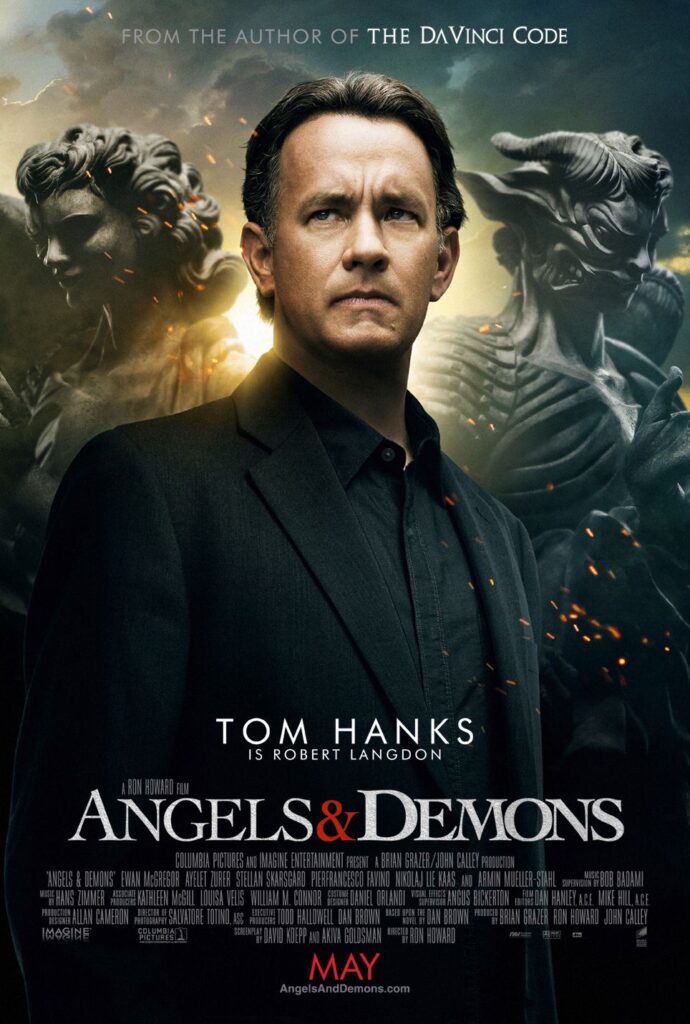
Tom Hanks dashes through a graceful Roman piazza, past an ancient Egyptian obelisk surrounded by fountains of water-spouting lions, his eyes focused on a church tucked into the corner of the square.
Moviegoers know that his character, Robert Langdon, is trying desperately to stop a grisly murder, following a trail of secret clues laid down nearly four centuries ago by the scientist Galileo and the baroque sculptor and architect Gianlorenzo Bernini. What they don’t know is that this graceful piazza itself harbors a dark secret.
Piazza del Popolo—and its namesake church, where Langdon is headed—was built to evict Nero’s ghost. This had been the hated emperor’s ancient family estate, and his likely burial spot, and area residents had for centuries complained that Nero’s evil spirit haunted a pine grove on the site. Finally, the Vatican chopped down the trees, exorcized the site, and built the piazza and its church “of the people.”
Many of Rome’s important sites are featured in Angels & Demons, the latest codes-and-clues thriller courtesy of author Dan Brown, director Ron Howard, and leading man Tom Hanks.
These Roman spots are full of secrets and scandals, and while the movie reveals several—and invents a few more to serve its plot involving Illuminati assassins and Renaissance intellectuals—the true miraculous and demonic events that took place at them are often even stranger than those Dan Brown’s imagination could whip up.
First, a reality check: the movie’s church interiors aren’t the real deal. Howard wasn’t allowed to film inside any of them, especially in the Vatican. (Actually, no one can shoot movies in the Vatican, not even the producers of the official John Paul II biopic.)
However, plenty of the exteriors are genuine, and Roman life occasionally intruded on filming. At one point, Hanks reportedly halted production to help a bride cut through the set—even holding her train—so she wouldn’t be late for her wedding inside the Pantheon.
What the movie doesn’t say, though, is that the Pantheon—an ancient pagan shrine that survived barbarian sackings and became a church in AD 609—was pillaged by none other than a pope.
In the 1600s, Pope Urban VIII (a member of the powerful Barberini family) seized the bronze revetments from the Pantheon portico’s ceiling and had them melted down to make cannons for the papal stronghold, Castel Sant’Angelo. (The act led to the infamous phrase, “That which even the barbarians wouldn’t do, Barberini did.”)
We’ve rounded up the inside scoop on the movie’s most noteworthy sites and crafted a tour that follows in the footsteps of Robert Langdon but goes well beyond Angels & Demons to reveal some of the even weirder—and true—sagas, scandals, and miracles of the Eternal City.
When you go see the movie, keep our handy guide close (spoiler alerts ahead, however!) while you’re reaching for the popcorn.
Piazza San Pietro
The Site: The piazza before St. Peter’s is a perfect ellipse; stand on one of the foci (marked red circles between each fountain and the central obelisk) and you’ll see the closest set of columns line up perfectly.
The Plot: Langdon races through crowds thronging the piazza to stop a murder near a Bernini carving.
The Scandal: Piazza San Pietro is baroque stagecraft at its best—and Mussolini did his best to ruin it. Bernini designed the sweeping semicircular colonnades as enormous arms to embrace (and impress) pilgrims emerging from the labyrinthine medieval alleys of the surrounding Borgo neighborhood. In 1936, Il Duce razed the Borgo to create the modern, bombastically monumental boulevard approach.
Castel Sant’Angelo
The Site: In the year 590, as he prayed for Rome’s deliverance from a plague, St. Gregory the Great had a encouraging vision of an angel sheathing its sword above this massive brick castle built atop the drum of Hadrian’s first-century mausoleum. The plague ended, and the castle got a new name (and, in 1752, a spiffy bronze statue of the angel).
The Plot: Langdon has a showdown with an assassin in a chamber near the top of the castle.
The Scandal: Castel Sant’Angelo is connected to the Vatican by the passetto, a long wall topped by covered passage allowing the pope to scurry to his stronghold in time of need—as did Pope Clement VII did during the sack of Rome in 1527. It was the only known time a Pope used the Swiss Guard as a human shield, leaving the bulk of them to die covering his escape.
Piazza Barberini and the Capuchin Crypt
The Site: Today a busy traffic circle, the piazza centers on Bernini’s masterpiece fountain of a Triton (merman) spouting water into the air from a shell held to his lips.
The Plot: Since Dan Brown needed a church associated with Bernini on a square that once held an obelisk, he used artistic license to move Santa Maria della Vittoria several blocks down here to Piazza Barberini.
The Secret: Dan Brown missed a golden opportunity to work into the plot the Capuchin Crypt, a grisly set of chapels decorated with the bones of dead monks—wall of skulls here, scapula chandelier there—a few doors up Via Veneto, beneath Santa Maria Immacolata Concezione church.
Santa Maria del Popolo
The Site: This 15th century church—replacing an 11th century shrine built to exorcize Nero’s evil ghost—was decorated by some of the titans of Renaissance and Baroque art, including Caravaggio, Pinturricchio, Sansovino, Raphael, and Bernini.
The Plot: Hot on the trail, Langdon descends into the terrible crypt beneath the Chigi Chapel.
The Secret: The Chigi Chapel, designed by Raphael and completed by Bernini, commemorates Agostino Chigi, a Renaissance banker famous for throwing lavish feasts at his riverside villa. Like a debauched emperor of old, he had servants fling the soiled silver plates into the Tiber after each course. (No fool, he also had nets and a recovery squad downstream.)
The Vatican Necropolis
The Site: Contrary to what the book says, you can tour the spooky 1,900-year-old necropolis deep beneath the Vatican [vatican.va], a buried cemetery of narrow lanes threading pagan and Christian mausoleums. To visit, you must apply in writing (preferably months in advance) to the Ufficio Scavi, stating the number and names of your party, tour language, and when you’ll be in Rome (scavi@fsp.va; fax +39-06/6987-3017).
The Plot: Our heroes dash through the darkened St. Peter’s and descend into the Vatican Necropolis in an attempt to foil a nefarious plot and save thousands of lives…
The Miracle: The tradition that St. Peter was reburied in the necropolis in the 4th century behind a “Red Wall” was dismissed as a medieval myth—until the wall was discovered in 1941, covered in ancient pilgrim graffiti.
Santa Maria della Vittoria
The Site: This riotously baroque 17th-century church is most famous for Bernini’s lavish Cornaro Chapel.
The Plot: Langdon gets chased through the burning church.
The Secret: Bernini transformed the Cornaro Chapel in into a theater stage. Members of the Cornaro family, which bankrolled the chapel, peek out from ingenious high- and low-relief “box seats” on the walls (accompanied by Bernini, last guy on the left), and what they’re watching is infamously scandalous. St. Teresa of Avila—draped in a flowing mass of folded robes, head thrown back, mouth half-open in a moan—writhes beneath a smiling, spear-wielding angel. It’s meant to portray a moment of religious ecstasy, but few who see it can help wonder whether Bernini was inspired by something more earthly.
Piazza Navona
The Site: This lovely piazza—which was often flooded in the 19th century for mock naval battles—is one of Rome’s most popular and pretty squares, with café tables and street artists surrounding Bernini’s extravagant Four Rivers Fountain. It owes its long, oval shape to the ancient Stadium of Domitian, the ruins of which serve as a foundation for the surrounding buildings.
The Plot: Langdon engages in a frantic underwater fight to rescue a cardinal.
The Miracle: Few of the piazza’s thousands of daily visitors venture into the church of Sant’Agnese in Agone, preserving the miraculous skull of St. Agnes, patroness of virgins and girls. In AD 304, a 13-year-old Christian named Agnes was sentenced to death for refusing to marry a powerful pagan. Roman law wouldn’t allow the murder of a virgin, so she was dragged to a brothel on this site and stripped. She prayed, and her hair grew to cover her nakedness. Soldiers hacked off the hair, but every lecherous man who looked upon her was blinded. They tried burning her at the stake, but the fire wouldn’t light. Beheading, sadly, did the trick.
The Basilica of St. Peter’s
The Site: St. Peter’s was built to impress: 198 feet wide, 145 tall, and 614 long (brass floor plaques show how much shorter other famous churches are), with cherubs the size of linebackers and enough great art to fill two museums.
The Plot: A key clue is uncovered in the warren of papal tombs called Vatican Grottoes, sandwiched between the current church floor and that of Constantine’s basilica, which it replaced.
The Scandal: Michelangelo’s Pietà (it’s the only work Michelangelo ever signed—look on the sash across Mary’s chest) has been behind bulletproof glass since 1972, when a crazed geologist attacked it with a hammer, hacking off Mary’s nose and fingers while screaming, “I am Jesus Christ!”
Tiber Island
The Site: The only island in the Tiber River within Rome is connected to the shores by the Ponte Fabricio, built in AD 62 and still in use by pedestrians today.
The Plot: Langdon is lucky to splash down in the river right by this island, famed since antiquity as a site of healing.
The Miracle: In 293 BC, with Rome in the grips of a terrible plague, the Senate voted to appease Aesculapius, god of healing. As a ship bearing the appropriate statue of Aesculapius sailed up the Tiber, a huge serpent—a symbol of the god—slithered off the boat and onto the city’s only island. Good omen. A temple was built there, the plague lifted, and pilgrims came from the farthest provinces to spend the night and pray for healing. The island remains home to a major hospital, the Fatebenefratelli, founded in 1548.
The Pantheon
The Site: This ancient rotunda, today a church dedicated to Mary and “all the martyrs,” was built as a pagan temple (dedicated to “all the gods”) nearly two millennia ago.
The Plot: Langdon’s hunch that the secret Illuminati trail begins at Raphael’s tomb in the Pantheon turns out to be a red herring.
The Scandal: Pope Urban VIII—who went from championing the theories of Galileo to ordering his imprisonment for heresy—was responsible for several insults to the Pantheon. In addition to melting down the portico’s bronze revetments to make cannons for Castel Sant’Angelo (and the altar canopy in St. Peter’s—designed by, who else? Bernini), he also commissioned Bernini to graft onto the Pantheon’s façade a squat pair of towers so ugly they were rounded derided as “Bernini’s Ass Ears” until they were finally removed in the 1880s.