Just across the river from the Uffizi Galleries lies the Oltrarno, Florence’s traditional artisan’s quarter. As soon as you step off the Ponte Vecchio, a medieval bridge barnacled with tiny goldsmith shops, you’ll see a pocket-sized boutique called Madova, opened in 1919 by Amadeo Donnini.
Inside, surrounded by inventory cubbies set into the walls almost to the ceiling, four of Donnini’s grandchildren carry on the family tradition of crafting some of the finest leather gloves in the world.
A clerk takes just one glance at your hand before perusing the walls and gathering a selection of gloves lined with silk or cashmere and stitched from buttery kidskin in an array of colors.
The clerk asks you to rest your elbow on a tiny velvet pillow on the counter so she can slip on her wares for you to try. One style looks like sober black dress gloves, until your hand moves and bright colors flash from swatches hidden between the fingers—elegant, yet playful.
Each fits… well, like a glove.
That is what “Made in Italy” means in the fashion world: an attention to the smallest details of the craft and a mastery of the artisanship; the impression that everything is perfectly made to measure even when it is not; an appreciation for a discipline steeped in generations of cherished tradition but unafraid to be modern and fun.
Though Madova has stocked glove departments from Saks Fifth Avenue to Neiman Marcus, Bloomingdale’s to Burberry, it still operates out of just the one tiny shop (and, these days, a website).
Several of Madova’s Florentine neighbors, however, have moved on to international fame and fortune, becoming Titans of twentieth century fashion. In fact, unlike some of the ever-internationalizing brands from Milan and elsewhere, the famous fashion houses founded in Florence still embrace—and epitomize—the “Made in Italy” ethos.
How Gucci Got its Gs
As a lift boy at London’s Savoy Hotel in the early 1900s, Florentine teenager Guccio Gucci admired the guests’ elegant and sturdy bags. When he returned home to Florence in 1921 he opened an English-style luggage store.
Gucci’s wares soon became fashionable among the moneyed horsey set, who commissioned many equestrian-oriented items. This—and a family legend of that the Guccis had been saddlers in the Renaissance—inspired some of the brand’s equine symbols used to this day: the horse-bit spangle across the tops of Gucci loafers; the green-and-red striped ribbons mimicking a cinch strap.
The lean World War II years led Gucci to focus on easy-to-acquire local materials, like hemp, linen, and jute. One invention of necessity became an instant classic: Bamboo could still be imported from Italy’s ally Japan, so Gucci’s craftsmen devised a purse with a handle of burnished bamboo bent into a saddle-like curve and attached to a pebbled pigskin bag.
By the 1960s Gucci bags had become stars in their own right when seen on the arms of everyone from Jackie Kennedy and Liz Taylor to Peter Sellers and Samuel Beckett.
Despite fame and fortune, the Gucci firm has remained committed to its core ideals throughout the decades. “This artisan tradition, transmitted from generation to generation, continues to be a point of great pride for Gucci,” the company affirms, and it guarantees that, “100% of Gucci leather, footwear, and clothing are still produced in the Florentine studios, which provide work to 45,000 people in Italy alone.”
That is in part because “Made in Italy” is not just a label. It is a law.
Made in Italy—The Brand
In 2009, Italy passed among the world’s strictest “Made in…” labelling regulations. Fans of legalese can read the full rules and sub-rules for “100% Made in Italy” certification at www.madeinitaly.org, but it boils down to this: The product must have been created and manufactured entirely within Italy to the company’s exclusive designs; using Italian workers, traditional methods, and grade-A natural materials; and in hygienic and safe working conditions.
Such devotion to tradition and quality has paid off. In 2013, the Boston Consulting Group conducted a survey of 10,000 luxury consumers in 10 countries.
The survey found that the “Made in Italy” label on luxury goods ranked number one in consumer confidence for the categories of Clothing, Accessories, and Jewelry (France took second place in each)—and Italy was beaten in “Watches” only by the Swiss, and in “Cars” only by the Germans.
Jay Lipe, a Senior Lecturer in Marketing at the Carlson School of Management who runs an advanced spring course on “Made in Italy” Brand Management in Florence and Rome, says that merely the existence of a “Made in Italy” label conjures in the consumer’s mind, “This idea of a certain quality of the raw materials, of an element of craftsmanship, and of a skilled artisan who is involved in the final processing.”
Gucci: Looking Back; Looking Forward
So it’s no wonder the most celebrated Italian brands celebrate their Italianness. In 2011, Gucci even opened a museum and indoor/outdoor cafe at the heart of Florence in a stately palazzo that had been, appropriately enough, the seat of Florence’s medieval merchant guilds.
Overlooking the Palazzo Vecchio and Uffizi on bustling Piazza della Signoria—“the Living Room of Florence”— this was where the city’s powerful wool manufacturers, cloth importers, furriers, and silk weavers once held sway. Their guilds’ time-worn stone crests are now on display in the bookshop, replaced on the facade by the new crest—featuring a suit of armor carrying Gucci handbags—of the palazzo’s latest resident.
Inside, the Gucci Museo is a mix of museum and boutique, with glass displays cases featuring classic Gucci designs and exhibits focused on both the historic and contemporary fashion industry as well as the ever-evolving story of Gucci itself—because making everything old new again is part of the “Made in Italy” phenomenon.
In 2015, Gucci promoted a relatively unknown 43-year old associate designer named Alessandro Michele to Creative Director, and he has re-embraced that sense of elegance-meets-fun that defines Florentine fashion.
Michele has brought back the floral prints and swishy fabrics once beloved by Princess Grace Kelly. His exciting new designs mix Art Nouveau details, 1920s Flapper style, hippie peasant dresses, and the classy lines of mid-20th century fashion—and he has returned the brand’s famous interlocked Gs to pride of place in the roster of pattern and clasp designs.
In picking ”The Top 5 Spring ’16 Shows in Milan,” Vogue went so far as to say that “Alessandro Michele has reversed Gucci’s fortunes, and reoriented the general direction of fashion while he was at it,” noting the designer’s “…nods not just to Gucci’s heritage, but also to other Made-in-Italy icons.” The designer himself said he was thinking about both the Renaissance and the 1970s to bring “…Italian vintage vibes to the runway.”
American artist and tastemaker Rachel Feinstein said that Michele’s Gucci Spring 2016 Collection, “Exemplifies the perfection of Italian craftsmanship that doesn’t exist anymore anywhere else; that everything’s made impeccably.”
Fancy Footwork
The Gucci Museum also—naturally—has small shop on site, but the company’s main Florence boutique is on Via de’ Tornabuoni, the main artery of Florence’s shopping district. Anchoring the base of this boulevard, a block south of Gucci, the mighty 14th century Palazzo Spini Feroni rears its castle-like, battlemented profile of honeyed stone against the Florentine sky.
A luxurious hotel in the 19th century, when composer Franz Liszt was a guest, the palazzo became the seat of the Municipality of Florence during the city’s brief 1860s reign as capital of the new Kingdom of Italy.
In the 1930s, a Naples-born cobbler named Salvatore Ferragamo purchased the palazzo, filling its frescoed halls with craft workshops, fashion ateliers, and offices for what was by then already a famous footwear empire.
Ferragamo had crafted his first shoes—for his sisters’ confirmations—at the age of nine, was apprenticed to a cobbler in Naples at 11, and opened his first shoe shop by age 13.
Three years later, in 1914, Ferragamo emigrated to America to join his brother on a shoe and boot assembly line outside of Boston. Impressed by the industrial techniques he saw, but beholden to Old World craftsmanship, Ferragamo soon decamped to Southern California to create his own alchemy of modern methods and the traditional cobbler’s art.
By 1923, L.A. newspapers were calling Ferragamo the “shoemaker to the stars.” His client list rolls by like the credits on a dream picture starring nearly every early 20th century Silver Screen goddess: Ingrid Bergman, Lana Turner, Mary Pickford, Rita Hayworth, Ava Gardner, Bette Davis, Marlene Dietrich, and Katharine Hepburn.
Ferragamo succeeded not just because he crafted impeccably elegant, occasionally outrageous confections and slipped them onto famous feet to grace Hollywood’s red carpets. He emphasized comfort as much as style, attending mathematics and anatomy courses at USC to puzzle out how to distribute body weight over the arch of the human foot.
This lead him to his patented steel support shank and widely-imitated cork “wedge,” and to supplement traditional shoe sizing with new measurements of width and volume. His research allowed Ferragamo’s teams of artisans to mass produce shoes that retained the elements of a made-to-measure fit—the brand still offers more than 70 fit/size combinations.
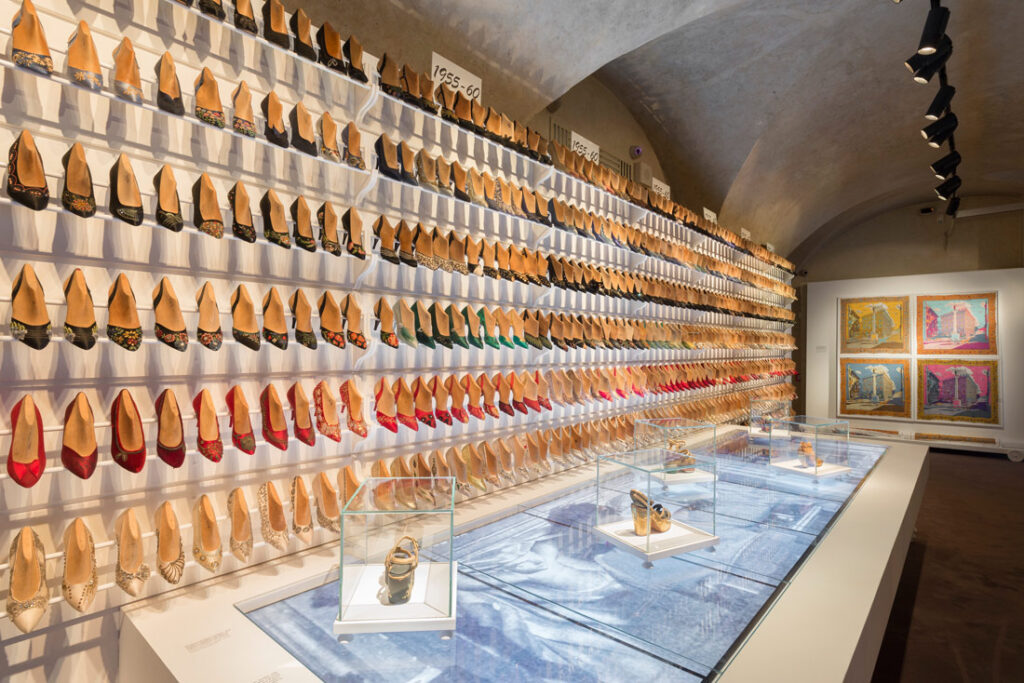
Ferragamo returned to Italy in 1926, and decided to settle in the emerging fashion capital of Florence, where he eventually turned the Palazzo Spini Feroni into not only a global headquarters for his brand, but also a museum containing famous shoes made for famous clients, including Marilyn Monroe, Greta Garbo, and Audrey Hepburn. (The Ferragamo firm continues its Hollywood tradition—especially on period shoots—providing footwear for everyone from Madonna as Evita to Meryl Streep as The Iron Lady.)
In 1947, Ferragamo became only the second Italian—and first shoemaker—to win the 20th century fashion world’s version of the Oscar, a Neiman Marcus Award (a feat his daughter Fiamma would repeat two deades later when she led Ferragamo).
Like his Florence neighbors, Gucci and Pucci, Ferragamo and the house he founded achieved worldwide fame without losing sight of what the “Made in Italy” label means, or of the important role Italian artisan traditions played in his success.
Ferragamo wrote in his autobiography. “All over Italy – even today, and in the cities as well as the poor villages – you will see cobblers sitting in their tiny stone rooms, surrounded by heaps of shoes all higgledy-piggledy, working crouched over their lasts under the beam from a naked electric-light bulb.”
That was written half a century ago, but wander the side streets of the Oltrarno neighborhood near Madova gloves today and you can still glimpse the exact same scene through the open windows of 21st century Florentine shoemakers.
They sit in their shops, stacks of leather heaped on the tables and garlands of carefully planed wooden forms dangling on the walls, painstakingly stitching tooled leather to soles, serving as constant, living reminders to their more famous and fashionable Florentine neighbors to remain true to what it means to be “Made in Italy.”
Sidebar: Bottling the “Made in Italy” essence
The musky scent wafting through Gucci designer Alessandro Michele’s personal studio is a potpourri sold by the Farmaceutica di Santa Maria Novella.
Among the world’s oldest pharmacies, it was founded in the 13th century by Dominican monks, who ran it until 1866, when the new Italian State began seizing the Catholic church’s non-ecclesiastical assets. The final monastic proprietor, Damiano Beni, instead shrewdly passed ownership to a nephew, in whose family it remains.
The Farmacia’s health and beauty products are now carried in upscale pharmacies across the world (and at The Drugstore on the Wynn Esplanade), but you can also still shop in the vaulted and frescoed rooms of this venerable apothecary’s 17th century offices on Via della Scala in Florence.
You can also visit the gardens where the still grow most of the herbs and ingredients used in their products; it’s located by a Medici villa just outside Florence and open for guided tours Wednesday afternoons.
Sidebar: Getting Made to Measure without going to Italy
In February of 1951, a Florentine antiques and art dealer named Giovanni Battista Giorgini took it upon himself to make Italian clothing fashionable—and exportable.
Giorgini invited buyers from the biggest North American companies (and a correspondent from Women’s Wear Daily) to swing by his Florence villa after the annual Paris runway season. As part of the soirée, Giorgini mounted Italy’s very first fashion show, featuring among others the swirling, colorful designs of a local Florentine Marquis named Emilio Pucci. The gamble worked, orders poured in to local ateliers, and “Made in Italy” became fashionable.
In 1952, this Florentine exhibition of Italian designs moved into Sala Bianca of the Pitti Palace museum, where Roman fashion house Brioni hosted another world’s first: A men’s fashion show. Since “male models” did not exist at the time, Brioni staff and store managers simply paraded the catwalk in their best suits.
Florence’s annual fashion parade has since introduced such young designers as Valentino and Armani to the world, and today’s “Pitti Immagine” calendar encompasses a half-dozen annual fashion shows in the vast halls of Florence’s Renaissance-era Fortezza del Basso. However, you no longer have to make the pilgrimage to Italy to get a bespoke Brioni Su Misura suit like the one Daniel Craig wore in Casino Royale (Pierce Brosnan’s Bond was a Brioni man, too).
The Brioni boutique at the Wynn Las Vegas is the only store in the U.S. to offer Miror technology, a kind of virtual closet using a computerized 3D tailoring system that allows you and your tailor to sample and chose between 1,500 fabrics and eight million styling combinations.
While the suits may be assembled in Vegas to your specifications, it is still a “Made in Italy” experience. All Brioni master tailors are trained at the company’s School of High Fashion in the Abruzzi Mountains, where they learn, “220 steps of workmanship. From the drawing to cutting and tacking phases, to the shoulder construction and placement of buttonholes, down to the ironing phase, they know each step necessary to bring a Brioni suit to life.”
Sidebar: When you go
Madova
Via de’ Guicciardini 1r, Florence, Italy
tel. +39-055-239-6526
www.madova.it
Gucci Museo
Piazza della Signoria 10, Florence, Italy
tel. +39-055-7592-7010
www.guccimuseo.com
Gucci flagship boutique
Via de’ Tornabuoni 73r–81r, Florence, Italy
tel. +39-055-264-011
www.gucci.com
Museo Ferragamo
Piazza Santa Trinita 5r/Via de’ Tornabuoni, Florence, Italy
tel. +39-055-356-2846
www.ferragamo.com
Ferragamo flagship boutique
Via dei Tornabuoni 4r–14r, Florence, Italy
tel. +39-055-292-123
www.ferragamo.com
Officina Profumo – Farmaceutica di Santa Maria Novella
Via della Scala 16, Florence, Italy
tel. +39-055-216-276
www.smnovella.com