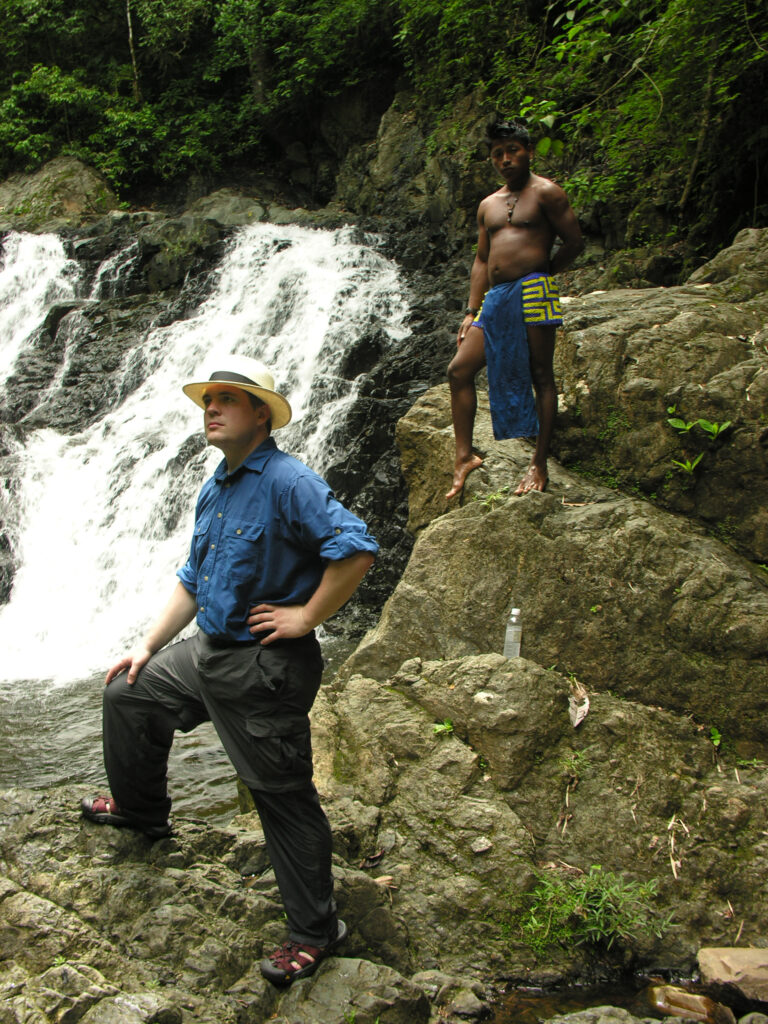
Olmedo poled our piragua (dugout canoe) to the shoreline on Panama’s Upper Chagres River. With a muted plastic clatter from his beaded blue and yellow ambura skirt, my Embera guide leapt lightly off the prow and scampered into the jungle.
I scrambled to follow him up a narrow dirt path along a small, clear stream. Olmedo moved fast, especially for someone warning no shoes, but luckily he would pause occasionally to indicate something interesting with his bare big toe: a polka-dotted mushroom, or a tiny tree frog that jumped when nudged.
When he came to a little red snake, however, Olmedo kept his foot a respectful distance away and merely pointed with his toe. I decided to give the snake a wide berth.
Olmedo and I stopped by a rock pool to wait for the others from our canoe to catch up. Fish darted around the water. I pointed to one with blue stripes. “Tilapia,” Olmedo said. “Good to eat,” he continued in Spanish. It was the longest sentence he’d said all day. Encouraged, I pointed to another fish, silvery and narrow.
“I don’t know the name in Spanish,” he said finally. Then, after a pause, “Also good to eat.”
The trail ended at a gorgeous waterfall and swimming hole. The 20-minute hike was easy, but the rainforest humidity left me soaked in sweat. Thankfully, when we returned to our piragua, our guide from Gamboa Tours (www.gamboatours.com; $99 for this eight-hour trip), Oscar Maxwell, shared some cans of Panama beer he’d packed.
We continued along the Rio Chagres. Olmedo stood at the prow, signaling which way to steer to the Embera manning the outboard motor and poling us through the shallows.
We were flanked by high walls of jungle, which fluttered with butterflies and teemed with unseen but noisy wildlife. Occasionally, we scared up a blue heron or a brightly colored kingfisher. Once, we passed an alligator sunning itself on the banks.
When we arrived at the grassy embankment at Tusipono, Olmedo’s village, a group of bare-chested women in bright skirts walked down the lawn to meet our canoe. Laughing children and several chestnut-skinned men clad only in juayuco (loincloths) trailed behind, including the chief, Antonio.
“In ancient times,” said Antonio in Spanish, “We Embera all had animal names.” I asked him when they had given up the practice. “Ancient times,” he repeated. I asked if his father had one. “No. He was Antonio,” said Antonio. How about his grandfather, did he have an animal name? “Yes,” Antonio said, but he wouldn’t tell me what it was.
We clambered up the notched ladder-log into a thatched hut on stilts—being six feet off the ground helps protect against grass insects, rainy season flooding, rodents, and jaguars. A young woman with a shy smile and a glorious beaded chest plate served us fried tilapia and patacones (fried plantains) on banana leaves.
While we ate, Antonio explained the traditional men’s tasks: fishing, of course, but also carving—wood from the coco bolo tree, richly veined in yellow, red, and black; and tagua pine nuts nicknamed “vegetable ivory.”
Guillermina, a formidable older Embera woman, expounded upon women’s duties, which included dying strips of chauga palm fronds red, green, black, and white, then spending months making them into baskets so tightly woven they can hold water. Women also used to weave their uhua skirts and men’s juayco from palm fibers, but now they use cheap printed fabrics from Southeast Asia bought in the city.
Later, in a communal hut where we visitors got traditional temporary tattoos in a blue-black ink made from jagua fruit, a band of flutes and turtle-shell drums started a jungle beat while the village women giggled their way through the hammock dance and the white-faced monkey dance. We tourists were invited to join in for the Embera Rhumba, which consisted of standing next to an Embera partner, holding hands, and shuffling in a circle.
While our little tour group browsed the baskets and carvings for sale, I sought out Antonio to ask (politely) how he felt about his people becoming tourist attractions.
“In ancient times,” he said, meaning 40 to 50 years ago, “My people moved here from Darién,” referring to the dense jungle along the Panama/Colombia border. I asked why they moved, and he said, “The Green Embera came one day with guns and told us we had to leave.”
To Antonio, everyone who lives in the jungle is “Embera,” even if they wear green fatigues, carry automatic weapons, and are guerilla fighters, drug cartel enforcers, or any of the other heavily armed bandits that infest the Darién.
When his people arrived here, according to Antonio, they were told that the Chagres was a national park and it was illegal for them to hunt. So they (gradually) put aside their blowguns and poison-tipped arrows and began growing rice, plantains, and vegetables for food and to sell in the markets.
Then, in the 1980s, the government told them that, since this was a park, the officials needed to take a percentage of the agriculture and its revenues.
“Now we work with tourists,” said Antonio, who seemed to think it was as good a job as any, and, as a group career for his little village of 14 families, had one enviable perk.
“You come in our canoes, and we are happy to show you our ways of life. That way we survive, and so does our culture,” said Antonio. “Too many Indians, they leave to live in the city and be poor,” he said.
“But now I see our children, they are growing up in the jungle. They learn our traditions from ancient times, and they remember to be Embera.”