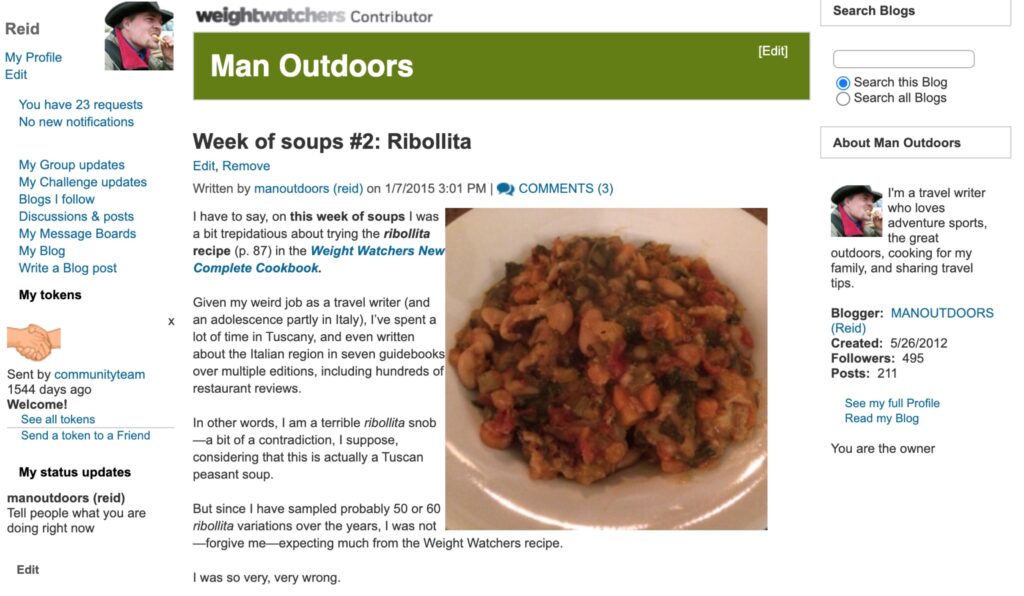
I have to say, on this week of soups I was a bit trepidatious about trying the ribollita recipe (p. 87) in the Weight Watchers New Complete Cookbook.
Given my weird job as a travel writer (and an adolescence partly in Italy), I’ve spent a lot of time in Tuscany, and even written about the Italian region in seven guidebooks over multiple editions, including hundreds of restaurant reviews.
In other words, I am a terrible ribollita snob—a bit of a contraction, I suppose, considering that this is actually a Tuscan peasant soup.
But since I have sampled probably 50 or 60 ribollita variations over the years, I was not—forgive me—expecting much from the Weight Watchers recipe.
I was so very, very wrong.
I’ve tried making ribollita at home myself several times, using everything from cookbook recipes from celebrity chef to instructions scribbled down by restaurant owners.
This quick and easy Weight Watcher recipe produced by far the most authentic results.
My previous ribollitas were sometimes decent—though never worth repeating—and one or two were spectacular failures—though that’s really on me and my youthful misunderstanding of some vital ingredients.
See, technically a ribollita can have pretty much anything in it. It’s name means “re-boiled.” You take whatever yesterday’s soup was, pour it over slabs of yesterday’s bread, and heat it all up. This makes the little bit of leftover soup go farther, and it softens up the otherwise stale bread for eating.
That said, all classic ribollitas share a few key ingredients in addition to the stale bread: cannellini (if you can’t find them, great northern white beans are similar), tomatoes, and cavolo nero.
See, it was that last one that tripped me up when I first attempted to recreate this Tuscan classic. “Cavolo nero” translates literally as “black cabbage,” which I had never heard of in English, so on my first go I just substituted red cabbage.
Huge mistake.
I ended up with a dirty grey, distinctly inedible Frankensoup, not to mention a cabbage stink that hung around the house for days.
I have since learned that cavolo nero is not cabbage at all, but a kind of kale. It is essentially what we call lacinato kale (sometimes sold as “dinosaur kale”)—though the Tuscan version has a narrower and darker leaf.
Armed with this knowledge and the Weight Watchers New Complete Cookbook, I managed to make the best homemade ribollita of my life.
As always, I altered the recipe a bit. I only used about half as much onion (inexplicably, most recipes out there vastly overestimate the amount of onion needed), as well as half the amount of bread (there’s no need to layer it, as in the recipe; just pour the soup over a single basement layer of bread slices).
I was also planning to use only half the stock called for, since I know the consistency of true ribollita is more of a stew than a soup. However, since the bread soaked up much of the liquid—and since dinner was unexpectedly delayed and the soup simmered for nearly six hours instead of one—I did end up with the full portion of chicken broth.
I also used considerably more olive oil. Yes, I know—but, hey: I skimped on the bread, remember? And that is a refined carb, rather than a healthy, natural fat.
Besides, in Italy they pour on enough olive oil that it could be technically considered the broth, so I was actually cutting back.
The result? This ribollita recipe has already received multiple requests to be added to the regular meal rotation.