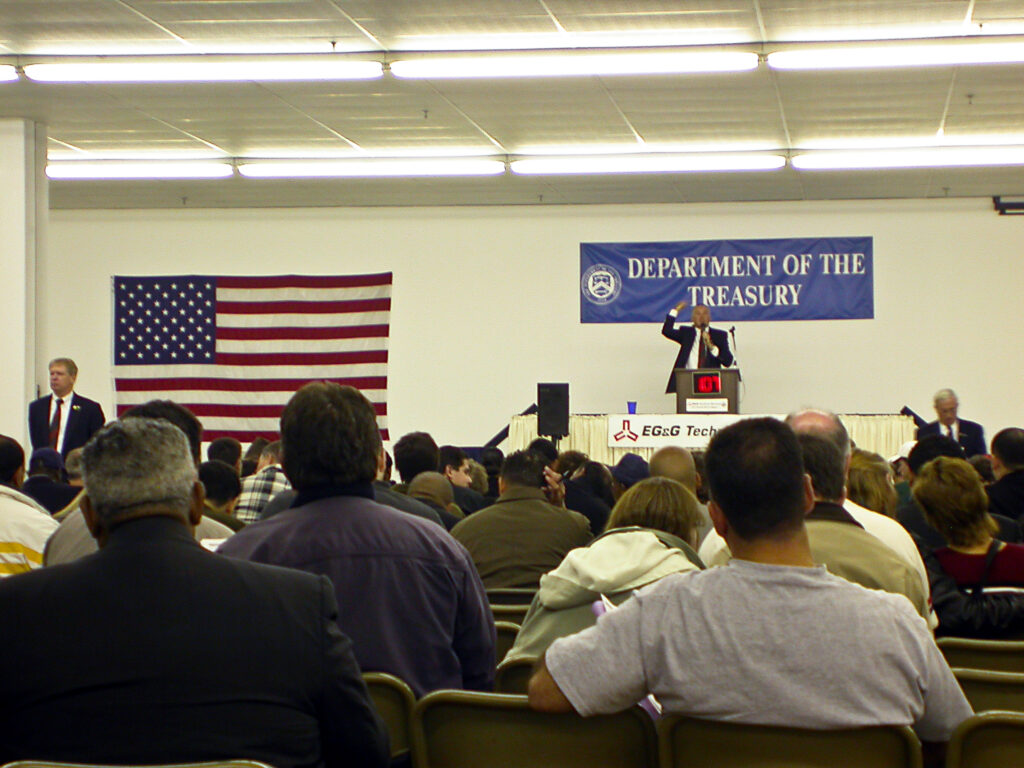
The police gain custody of criminal assets, the IRS seizes property in lieu of taxes, U.S. Customs acquires containers of unclaimed freight. Government agencies can’t stash this stuff in warehouses indefinitely, so they sell it to the public at auctions—enormous yard sales where all prices are negotiable.
While a few Federal auctions have gone online in recent years, most still take place in parking lots and warehouses on a regular schedule; you can find out when and where by following the links in the sidebar.
If you don’t happen to live near any of those, never fear—police auctions and sheriff’s sales take place in almost every town across the country, as well as on the Internet, so their rock-bottom deals can be enjoyed by everyone. Here’s how.
THE VIRTUAL POLICE AUCTION
While a few police departments still conduct old-fashioned live auctions (and most vehicles are still sold that way; see below), more are turning to the Web to sell seized property.
Some use eBay, but around 400 police departments in 27 states—from rural ten-man squads to the NYPD—now rely on Property Room (www.propertyroom.com). Founder Tom Lane, a former Long Beach detective, describes it as “a bargain site for consumers.”
It works a bit like eBay in that each item has its own auction timeline and you can raise your bid up until the last minute. Inventory changes hourly, with as many as 3,000 items on the virtual auction block at any one time. Since prices are determined by open bid, you can turn up great deals.
A Bose PM-1 CD player with noise-canceling headphones recently sold for $178—which sounds like a lot until you realize that the high-tech headphones alone retail for $299. A Bosch jigsaw that Amazon.com sells for $162.69 was, on Property Room, going for $79 when I last checked. A $190-value Toshiba color TV/DVD combo could be had for $104. And, with three hours to go until its auction closed, $363 was the leading bid on a set of golf clubs that, even used, was worth $740.
Sometimes you can even turn up rare gems: Famed hand-crafted Swiss ski maker Authier went out of business in 1992, at which time those last few pairs fetched up to $800. Property Room recently offered a pair of (slightly beat-up) Authiers for just $10.
Of course, most of the inventory was either owned or stolen by criminals, so there’s a preponderance of such things as two-way radios and police scanners, bolt cutters, digital cameras, cell phones, and other tools of the modern criminal trade.
There’s also a whole lot of jewelry because, as Lane explains. “A lot of jewelry is stolen; it’s easy to carry.” Professional appraisers authenticate such valuables for Property Room and determine a market value. “If the Rolex is fake, we destroy it,” says Lane. “If the jewelry is [fake], we mark it as ‘costume jewelry.'”
Still, there are some fantastic bargains: I saw a lovely 10K sapphire-and-diamond ring that was assessed for $960, but with one day to go, the top bid was a mere $345.
Also browse the “Just a Buck” page of items selling for $1: car stereos, brand-name sneakers, Trek bicycles, computer peripherals, VCRs, books, clothing, cordless drills, office chairs, cameras, and a boogie board. And that’s just a sampling of the pickings from Nov 3.
While it’s wise to be wary of bidding on a used item that you can’t heft in your hand and inspect closely, at least Property Room gives you details on the goods. There are several photos of each item, along with a short paragraph of scrupulously honest description that was clearly jotted down by a human being—bad puns and all. If the item is mechanical or electronic, they note whether or not it has been turned on and tested.
There’s a customer service number if you have problems—something you won’t find on peer-to-peer auction sites like eBay—and Property Room stands behind its assessments. If they said the camcorder was able to record and play back, and you can’t even get the thing to power up, they’ll take it back.
The one thing Property Room rarely lists is the one item most often associated with police auctions: automobiles.
THE FAMOUS $500 CAR
In the classic opening scene of Blues Brothers, Elwood (Dan Ackroyd) picks up Jake (Jim Belushi) from prison in a beatup black-and-white 1974 Dodge Monaco he bought at police auction. “This was a bargain,” Elwood says. “They were practically giving them away.” Jake replies sarcastically, “Well, thank you, pal. The day I get out of prison, my own brother picks me up in a police car!”
Irony aside, Elwood probably should have chosen a different set of wheels. Cop cars tend to be driven hard and right up to the end of their useful lives. They’re put out to pasture when the police mechanics can no longer justify the cost of keeping them running.
Luckily, the bulk of cars at a police auction are private vehicles that have been seized, impounded, or abandoned. The pickings run the gamut from burnt-out wrecks haggled over by scrap and parts merchants, to rust-spattered jalopies waiting for some student who can spare a few hundreds bucks and the time to fix them up; from decent middle-aged, middle-run vehicles bid on by used car dealers, to nearly new prestige rides seized from criminals who were livin’ large until the cops closed in.
Auctions may only be held once or twice a year in smaller municipalities, or as often as weekly in places like New York City. Finding out when and where these occur is as easy as calling your local police or sheriff’s department. (Don’t bother with the scam Web sites that promise to send you a list of local auctions for a fee.)
But can you really get a car for under $1,000? Artist Liz Atzberger paid $750 for a 1989 Jeep Wagoneer with 129,000 miels on it at Columbus, Ohio’s monthly police auction.
“It was a decent buy,” says Atzberger. “The car was worth about $5,000.”
Atzberger followed several important auction rules. She knew the car’s value, got to the auction early, and brought someone with more car savvy then herself: her father. But $750 wasn’t her final cost: the car needed about $1,000 worth of break work and wiring, and since the ignition key was missing (replacement: $50), it had to be towed off the lot (another $70).
After a year of driving around with no problems, Atzberger had to sink another $4,000 into the car during a breakdown-riddled trip to California. In the end, her $750 bargain ended up costing more than $5,800, but Atzberger—who says she has friends who bought cars at the auction with no problems—knew the car was a gamble to begin with.
“Sometimes it decides not to start. It leaks all kinds of crazy smells. If I didn’t love it, I wouldn’t still have it.” As a final insult, two weeks after the California trip, the Jeep was rear-ended in her driveway and totaled. “I truly think the car has a curse,” Atzberger says. “Because it lived a life of crime.”
Atzberger’s experience brings up some key points. There are three things you need to know about a car before you bid: its value (visit www.kbb.com, flip through a copy of Auto Trader, or surf eBay), its history (run its VIN through www.carfax.com), and its condition (have someone along who knows what kicking the tires is all about).
The box below goes into more detail, but the one crucial step is to set a price ceiling—somewhat less than a reputable dealer would charge—and stick to it, no matter how exciting the auction gets.
It’s amazing how quickly people can jettison common sense in the heat of a bidding war. At a Treasury Department auction in New Jersey, I watched as dozens of people jacked the price of a brand new, black, extras-loaded Infinity FX35 SUV to $35,000. But the woman with the winning bid didn’t actually have the money; she just got caught up in all the excitement. Upon realizing this, the annoyed auctioneers dropped the price back to the highest genuine bid made and started over.
In this case, the auctioneer was forgiving—and the car ended up selling for $35,195, some $8,250 below list—but at most auctions, if you score the winning bid you are obligated to buy.
Every auction is plagued by a few greenhorns who haven’t done their homework, and who can end up driving the price on the car you want way beyond what is reasonable. Let your reckless competitor tow it home and realize the mistake he’s made. You’ll live to bid another day.
BOX: Top Auction Tips from a Master
We asked Jeff Ostroff, CEO of CarBuyingTips.com, to share his top tips and strategies for navigating the pitfalls and price-points of a live auction.
1) Arrive early, before the crowds, so you can examine all the cars. Sometimes they’ll let you start the engines—even drive around the parking lot.
2) Determine the car’s value. There’s always the Kelley Blue Book, but it’s best to find out what the car actually sells for. Pick up a copy of Auto Trader at a newsstand or 7-Eleven and look up what private sellers (not dealers) are asking for the car—keeping in mind that the asking price is always a bit higher than what people actually pay. Surf eBay to see what people are bidding on similar cars—and watch the auction to the very end, because most winning bids come in during the last 20 seconds.
3) Learn the car’s history. If the car’s had four owners in five years, that raises a red flag. Some auctions provide the VINs (Vehicle Identification Numbers) ahead of time. If not, carry a wireless PDA and run the VIN numbers as you go, or bring a cell phone to call home where someone sitting at a computer can run the CARFAX reports for you—you’ll want their 30-day unlimited plan ($24.99), not the $19.99 one-vehicle fee.
4) Choose your car well. Remember: these cars aren’t maintained. They may have been sitting on the lot for six months. Open the trunk and lift up the carpet to see if there’s rust. Lift the seats to see if it’s been flooded. Open the doors and the hood to make sure all the VIN numbers match; If they don’t, it means the car’s been in a wreck and they grabbed parts off another car.
5) Determine any damage the car has sustained. If you’re not savvy, bring along someone experienced, like a body shop guy, who can look under the hood and tell whether the car’s been worked on and what problems it might have. A mechanic can tell if bodywork’s been done, if there’s welding on the frame, or whether the car has been repainted. Those can all be signs that something was wrong with the car.
6) Hang out with the people at the auction who are smarter than you. Look around for pros who really know what they’re doing, and then hover behind them taking notes and learning what to look for (and which cars are worthwhile). Buddy up with someone who has a Black Book—like the Kelley Blue Book, but one that dealers use—so you can get a sense of what the cars are going for in relation to what a dealer would pay.
7) Avoid problem cars. Insurance companies won’t touch salvaged vehicles. Warranties won’t cover cars with more than 60,000 miles on them. Never buy a car without the title; it’s more hassle than it’s worth.
8) Understand the rules of the auction. Usually you have to pay cash, and you have to put up a lot of money up front. Find out the return policy, if there is one. Cars are usually sold “as is”—no refunds, no returns.
9) Factor in the extra costs. Many auctions charge a 5% or 10% “buyer’s premium,” so figure that into your price along with taxes, fees, and any work that needs to be done. I can guarantee you that there’s going to be something to repair.
10) Settle on your limit, and don’t go above it, no matter how exciting the bidding gets. You’re at that auction to get that car for much less than it would cost on the market, so if the price starts getting near the true value, just walk away. You’ll be better off finding the car on the open market, where you can get it checked out by a mechanic and feel much more comfortable paying full value.
SIDEBAR
THE FEDS: OTHER GOVERNMENT AUCTIONS
US Department of the Treasury (www.treas.gov/auctions/customs) lists auctions for the Treasury and Customs departments, ATF bureau, and the IRS.
Government Liquidation (www.govliquidation.com) handles items from the Department of Defense, everything from camcorders and jeeps to desert-cammo fatigues and a slightly used Calvary horse named Recoil.
General Services Administration (gsaauctions.gov) sells a variety of government surplus, seized, and forfeited property.
GSA Fleet Vehicle Sales (www.autoauctions.gsa.gov) lists upcoming auctions featuring hundreds of used government cars.
HUD (www.hud.gov/homes) sells HUD homes.
US Postal Service (www.usps.com/auctions) holds monthly auctions in Atlanta of everything that got lost in the mail.
FDIC (www.fdic.gov/buying) disposes of real estate and other assets from failed banks.
NASA holds monthly auctions at the Goddard Space Flight Center in Maryland (sales.gsfc.nasa.gov) and at the Kennedy Space Center in Florida (surplus.ksc.nasa.gov)—don’t get too excited; it’s mostly surplus computers and electronics, not used space shuttles.
Bid4Assets (www.bid4assets.com) is a private auction site contracted by the U.S. Marshals, as well as a couple of states and counties.
Government Auction (www.governmentauction.com) handles a variety of federal land sales for a $99 closing fee.
FirstGov (www.firstgov.gov/shopping/shopping.shtml) links to dozens of government auctions, including many of those above plus things like the BLM and the National Park Service—in case you want to buy a lighthouse.