Day 1: Memphis, TN, to Clarksdale, MS
I’m not the church-going type, but after a Saturday night of booze and blues in the bars of Beale Street, the only proper thing for a man to do is to get saved. And in musical Memphis, the only proper place to do it is The Full Gospel Tabernacle, where in 1976 the Reverend Al Green went from singing soul to saving souls.
I’d brought along my dad, artist Frank Bramblett, not because his soul needed saving, or even because it happened to be Father’s Day (though that was a nice coincidence). I’d invited Dad on this musical quest from Memphis to New Orleans because he loves music, too, and I don’t think we’ve ever taken a trip together, just us guys.
After a quick stop at Graceland to pay our respects at the royal palace of rock and roll, Dad and I sidled into a pew at The Full Gospel just in time for the 11:30am service. There were 50 or so die-hard congregants, with a core constituency of ample women arrayed in their pastel Sunday best and matching hats. One brought a tambourine in her purse, and we soon learned why.
Church with Rev. Green combined the benefits of a full-body workout with a spiritual endurance test. The freeform, three-hour service included preaching, singing, anecdotes (both biblical and musical), and more singing, with copious amounts of dancing in the aisles throughout.
“If you feel the need to kick off your shoes and cut a rug,” said the reverend as septuagenarians rose from their seats to jitterbug with the Holy Spirit, “you go on ahead and dance!”
Rev. Green teased his guests—handfuls of curious fans like us clumped in the back pews—by singing, quietly but beautifully, a few lines of his golden oldie “Let’s Stay Together.” Then he flashed that million-watt smile and said, “Yes, I could sing that—but that won’t get you saved,” and launched into another gospel tune.
After church, exhausted and starving, Dad and I took our freshly cleansed souls south down Hwy. 51 into Mississippi. We stopped for the first food we saw: Old Venice Pizza on the courthouse square of pretty little Hernando.
For dessert we had gloriously thick French vanilla malteds at Velvet Cream, a roadside ice cream and burger shack, where a man in the parking lot spontaneously asked us, “Where y’all from?” I mention this only because it occurred everywhere we went. People along the southern Mississippi were almost pathologically friendly, and there seemed to be a 30-second rule when it came to strangers. Stand still next to anyone for more than half a minute and they’re obliged to stick out their hand with a wide smile and a “Where y’all from?”
Luckily, Dad was born in Georgia and raised in Alabama, so his ability to swap stories of small-town life in the Deep South helped soften the blow when I had to admit I was a damn Yankee. Not that anyone ever held it against me. They seemed to view being born a Yankee as a chronic condition, like lazy eye or gout and, if anything, pitied me and laid on the southern charm extra thick.
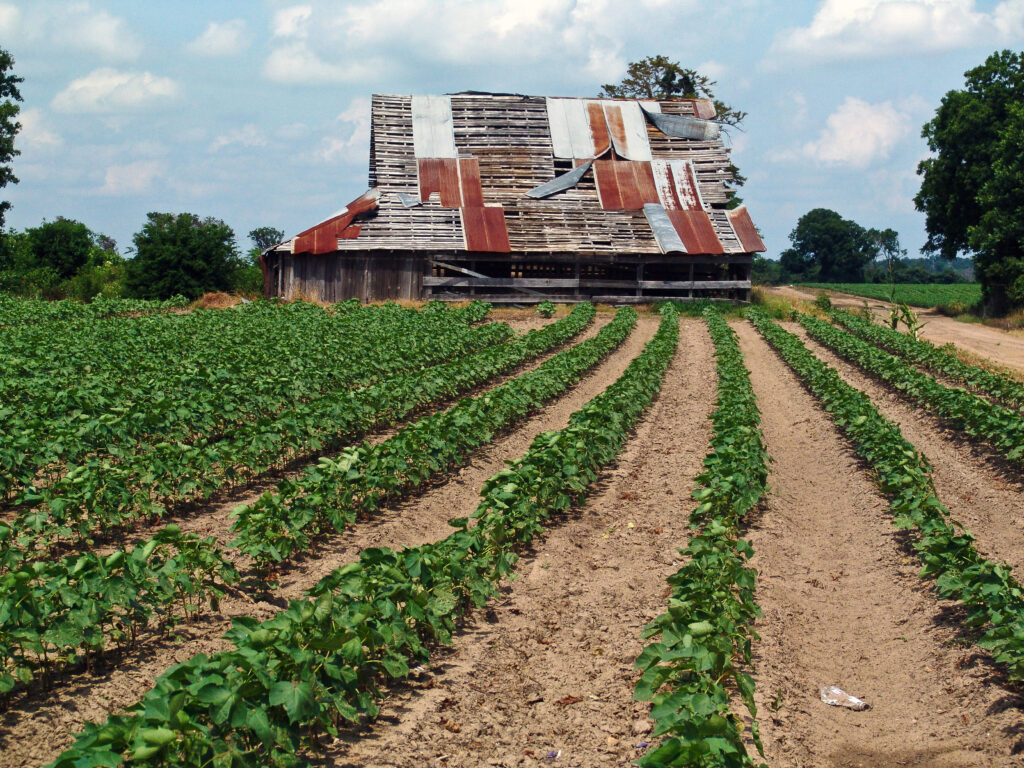
We continued south and as soon as we crossed the Coldwater River into Tate County, Rte. 51 became a causeway through swamplands flecked white with egrets, the still waters reflecting a cloudless sky between knobby knees of cypress. This was the Mississippi Delta, a vast and preternaturally flat alluvial floodplain of endless cotton fields and sun-baked crossroads towns. We were headed to its spiritual heart, the musical mecca of Clarksdale.
Clarksdale lies at the intersection of Routes 49 and 61 (recently renumbered 161), where we gobbled some pork sandwiches at Abe’s Bar-B-Q. Abe’s has been a Clarksdale tradition since 1942, but it’s not why this intersection is world-famous among blues fans. The commemorative sculpture of crossed guitars on a traffic island where 161 and 49 cross marks the most renowned (but least likely) candidate to be the Crossroads, where 1930s blues legend Robert Johnson supposedly sold his soul to the devil to become a guitar god.
Among the many problems with this most famous of Delta myths is that there’s no record of it being told about Robert until after his death. Some say it was bluesman Tommy Johnson who made the Faustian deal, including Tommy himself. Either way, I later learned this couldn’t possibly be the spot because Route 49 didn’t extend this far north until two decades after Johnson died the ultimate blues death—his whisky poisoned by a jealous husband.
Every trip needs a quest, and the search for the true Crossroads seemed perfect. In Clarksdale’s small but well-presented Blues Museum, where we paid homage to Muddy Waters’ reassembled shack, I saw a map of the Delta marked with half a dozen potential Crossroads candidates and dutifully copied them down.
At Cat Head, a store devoted to blues music and folk art, I picked up the Delta Blues Map Kit, a wonderful handmade guidebook (photocopied pages stapled together) written by record producer and Blues Hall-of-Famer Jim O’Neal. A treasure trove of information on the entire region, it also listed 11 Crossroads possibilities, including eight I hadn’t yet heard of.
We drove four miles south of the Clarksdale crossroads to the historic Hopson Plantation and its Shack Up Inn, a collection of genuine cypress plank-and-tin sharecropper’s shacks (updated with electricity, running water, A/C, TV, and WiFi), where we lucked into a last-minute cancellation. Our shack, appropriately enough, was called “Crossroads.”
The man at the front desk asked if we had come for that night’s concert at Ground Zero, a barn-like juke joint converted from a century-old railroad depot in downtown Clarksdale. The club, co-owned by Morgan Freeman and local lawyer Bill Luckett, usually features live acts only Wednesday through Saturday, but it turned out this was a special Sunday: Mose Allison was in town.
On the ride over, my father excitedly babbled about how he used to buy Allison 78s for 10¢ back in grad school. The joint was hoppin’, the beer was $2, and the music was terrific. Normally Allison’s more of a jazzman, but Ground Zero brought out his bluesier side.
We had been planning to continue south toward Vicksburg in the morning, but an invitation from a bearded man named Gregg Cook I met at Ground Zero changed our plans. Cook had driven down for the show from Helena, AK, where he was the curator of Helena’s museum-like Delta Cultural Center, one corner of which is set aside for a living legend of blues history.
Day 2: Clarksdale, MS, to Vicksburg, MS
“Pass the biscuits, ’cause it’s King Biscuit Time!” Sunshine Sonny Payne has opened his radio show with that phrase since 1951. Dad and I sat ten feet from where the 81-year-old Sonny was spinning records on the 15,342nd broadcast of the world’s longest-running radio show.
Payne was just a kid sweeping floors at the station on November 21, 1941, when Helena’s KFFA 1360 AM began shilling King Biscuit flour with 15 minutes of live blues by harmonica genius Sonny Boy Williamson II.
For the show’s first decade—during most of which Payne was off fighting World War II and playing bass for Tex Ritter and Ted Williams—Sonny Boy simply played live in the studio. He was usually accompanied by boogie-woogie piano pioneer Pinetop Perkins—a mentor to Clarksdale native Ike Turner—and guitarist Robert Jr. Lockwood. (The oddly placed “Jr.” emphasizes Lockwood’s hallowed place in blues history as Robert Johnson’s stepson, and the only man to whom Johnson ever gave guitar lessons.)
The show has since lengthened to half an hour every weekday, but it still starts at 12:15pm. As longtime listener Riley King once explained in an interview: “Being on a plantation, you had an hour off for lunch. I would come out of the field at noon. Sonny Boy Williamson would come on about 12:15. So, we had a chance to listen to live music from one of the guys I liked a lot…and KFFA was the only station in the area at that time that played music by black people.” That field hand later became a DJ and a noted guitar player himself, garnering the nickname “Blues Boy” King, soon shortened to B.B. King.
From Helena we crossed back into Mississippi and turned south on Hwy. 1, the Great River Road. We drove past old pecan plantations, and could smell the controlled crop burns even before we saw the chimneys of brown smoke rising over endless cotton fields.
Dad pointed to a chain gang working by the side of the road in white-striped green pants and said, “My dad used to do that.” I glanced over, wondering whether this was one story about Grandpa I really didn’t want to hear. But Dad was wearing his lopsided grin and chuckling. “I’d forgotten about that,” he said with the dazed look of someone recovering a childhood memory. Turns out when he was a kid riding in the car with his best friend’s family, he’d pointed at some prisoners working on a bridge and said the same thing. What he’d meant was that his father, among many other occupations, had riveted some bridges in his day, but for an uncomfortable few moments everyone in the car thought that Frank, Sr. had done hard time.
Just east of Beulah, I followed my homemade guidebook’s directions down back roads to the dirt and asphalt intersection of Frazier and Walton Roads, a more likely (and certainly more forlornly picturesque) candidate for the infamous Robert Johnson crossroads. Crop dusters buzzed low over the fields as I climbed a farm gate and tried to photograph the spot.
For a break from the blues, we made a quick stop along the banks of Deer Creek in Leland, MS. In addition to being yet another Crossroads contender (though the bland intersection of old US 61 and Rte. 84 didn’t impress me), Leland was also the boyhood home of Jim Henson. The future Muppeteer used to fish and catch frogs along this tranquil stretch of swampy river with his childhood pal, Theodore Scott, who like many southerners usually went by his middle name: Kermit.
Just south of Greenville, before zipping south to Vicksburg for the night, we detoured back across the Mississippi into Arkansas to drive a section of the levee just north of Lake Chicot State Park. At 640 miles, this is one of the world’s longest levees, rebuilt after the disastrous 1927 flood immortalized in so many early blues songs and re-created in O Brother, Where Art Thou? (The Coen brothers’ Homeric riff on life in the Depression-era Delta also incorporates the Tommy Johnson version of the crossroads legend and has Stephen Root’s radio DJ repeat the immortal line “Pass the biscuits!”)
The narrow gravel track atop the levee was one of the scenic highlights of our trip. Cattle and horses grazed on the levee’s grassy slopes. The unfarmed side of the levee, which flattened toward the river, was a dense swampland filled with egrets. Below us to the landward side, cotton fields stretched to the Arkansas horizon.
Day 3: Vicksburg, MS, to Breaux Bridge, LA
Built atop a 300-foot bluff above the confluence of the Yazoo and Mississippi Rivers, Vicksburg occupies arguably the most strategic spot on the Mississippi, and in 1862 Lincoln gave Union general Ulysses S. Grant the task of seizing it.
Grant devised a complex land and river campaign that’s still studied in military academies. After 14 months of fighting and a sustained 47-day siege of the city, the Rebel forces in Vicksburg surrendered on July 4, 1863. The Yankees gained control of the continent’s main supply route, the Confederacy never really recovered, and Vicksburg bitterly refused to celebrate the Fourth of July for nearly a century.
Vicksburg’s role as a lynchpin in our nation’s history helped make the museum in the Old Court House—where local planter Jefferson Davis, future president of the Confederacy, launched his political career—far more fascinating than I’d expected. It did an excellent job of bringing the Siege of Vicksburg to life through personal anecdotes and cases crammed with the choicest relics to be dug out of antebellum attics. My favorite exhibit was the Union Minnie ball—a .58 caliber lead bullet—said to have impregnated a local woman when it passed through her womb. (Don’t worry; the soldier who fired the shot did the honorable thing and proposed.)
The museum also strengthened my impression that the local consensus is that the Civil War was a terrible and brutal conflict bravely fought by honorable men on both sides, and that, sadly, the good guys lost. At the museum shop I picked up a handful of Minnie balls for $3 each and a General Robert E. Lee action figure.
It’s hard to escape the echoes of the Civil War in Vicksburg. The gorgeous 1840 Cedar Grove Mansion B&B where we had spent the night was proud of the grapefruit-sized Union cannonball still embedded in the parlor wall. The shelves in the Corner Drugstore, more homespun museum than pharmacy, were crammed with an armory’s worth of Civil War cannonballs, shells, and bullets—along with 19th-century quack medicine bottles, glazed XXXX moonshine jugs, and a once-working still with a cardboard sign outlining a recipe for homemade whisky.
We just had time before lunch to make a quick circuit of the Vicksburg National Military Park. Next to the largest Civil War cemetery in the country, its regiments of 17,000 white markers marching across rolling grasslands, we found the park’s best exhibit.
The U.S.S. Cairo is the country’s only (semi-)surviving Civil War ironclad, sunk off Vicksburg during the battle by a Confederate “torpedo” (really an early version of a sea mine) and preserved in the river mud’s anaerobic environment. In 1964, its timber skeleton, armor plating, cannon, and engines were raised from the riverbed and reassembled here. The adjacent museum contained some of the sailors’ personal effects dredged up with the wreck, including a pocket watch that, once cleaned and wound, started keeping time again.
At Walnut Hills, an 1880 home converted into a restaurant, Dad and I shared a giant round table with a Dallas family on their way to Charlotte. They had hit the road by 7am just to be sure they’d reach Walnut Hills by lunchtime. The reason was the table’s massive lazy Susan ringed by platters overflowing with country fried steak, lima beans, okra, mustard greens, coleslaw, sweet potatoes, black-eyed peas, rice, biscuits, and cornbread. We spun the table, sharing the bounty, swapping travel stories, and guzzling iced tea until it was time for the apple cobbler and the bill: $15 each.
From Vicksburg we turned east to pick up the Natchez Trace. This gorgeous two-lane ribbon of asphalt followed an 8,000-year-old trail from Nashville to Natchez used by everyone from ancient Indians to Spanish conquistadors to early settlers. The Trace operated a bit like a national park, with signposted roadside stops where we could get out and explore. We wandered the overgrown 19th-century ghost town of Rocky Springs, of which all that remains are the church, a well, and two slowly rusting safes. Just north of Port Gibson we walked an evocative, sunken stretch of the original trail cocooned in trees. Near Natchez we climbed Emerald Mound, the country’s second largest (after Cahokia in Illinois) ceremonial Indian mound, a vast plateau of earth created by the ancient Mississippian culture, predecessors to the Choctaw.
By late afternoon we were cruising past the stately antebellum homes of Natchez, where we discovered a parking lot on North Broadway with sweeping views up the Mississippi River. We debated a restaurant meal by the old riverfront, but with the weather turning nasty and a three-hour drive ahead, we opted instead for the quickie dinner and guarantee of heartburn offered by Fat Mama’s Tamales.
Handing Dad the car keys, I ordered a “knock-you-naked” margarita and happily spent the next three hours with my camera pressed against the rain-streaked windshield, convinced that, against all odds, I would capture a picture of the spectacular lightning playing across the clouds as we headed south through magnificent thunderstorms into Louisiana.
Day 4: Breaux Bridge, LA, to New Orleans, LA
I knew that Bayou Boudin & Cracklin in Breaux Bridge, LA, was going be a perfect place to spend the night when I had called for a reservation and couldn’t understand a word the guy on the other end was saying.
Rocky Sonnier spoke in a swamp-thick Paul Prudhommese, punctuating every sentence with a deep chuckle, so all I could make out was that he was (a) definitely Cajun and (b) really friendly. He had eventually passed the phone to his wife, Lisa, who watered down her accent and peppered it with enough English that I managed to book one of their cabins overlooking the Bayou Teche with a back porch symphony of frogs to lull us to sleep.
The Sonniers greeted us at breakfast in the main Acadian house, built in 1869. After I inhaled a “Cajun Platter” of cracklin’ (fried pork rinds), boudin sausage, eggs, and hoghead cheese (a terrine made from pig’s-skull scrapings), Lisa Sonnier asked about our plans. I said I’d been looking forward to a swamp tour. She whipped out her phone to call a local guide while my dad panicked. “Wait,” he said. “You never said anything about a swamp tour.” Dad is afraid of snakes; something about a run-in with a nest of rattlers back when he was a kid.
Eventually, I talked my reluctant father into it, and we drove south of town to Lake Martin to meet Walter “Butch” Guchereau, a wiry Breaux Bridge native with a crawfish skiff and degrees in zoology and botany. His knowledge stretched from local history and bird biology to the meaning of “bayou” (derived from a Choctaw word for slow-moving stream) and the habits of water snakes (which did not make Dad happy).
Butch spent two hours threading his boat through floating blankets of water hyacinth and labyrinths of cypress kneeling in the swamp waters, their branches dripping with gray-green tangles of Spanish moss, and past a vast bird rookery where hundreds of giant white egrets flapped from tree to tree in a scene straight out of Land of the Lost.
With 256 bird species living or passing through the swamp, our ornithological lesson didn’t end with egrets. I’ve never seen so many different birds: great blue herons, little blue herons, yellow-crowned night herons, purple gallinules, Mississippi kites, white ibis, anhingas, roseate spoonbills, and a peregrine falcon…and those are just the ones I remembered to jot down. I know I was meant to get most excited by the two small alligators we found sitting on logs, for me the birds were the highlight of the tour.
I had picked Breaux Bridge as our main stop in Cajun country because, as crawfish capital of the world, it is where crawfish etouffée was invented. It is also home to the renowned Café des Amis, converted from an old 1890s general store in 1992 by former state legislator Dickie Breaux, descendent of the town founder. This place is so Cajun they feature live zydeco music during Saturday breakfast, though Wednesday lunch—I had a crawfish-stuffed chicken breast topped with etoufée—didn’t disappoint, either.
Frankly, nothing topped the swamp tour as we made our lazy way east to New Orleans along Routes 31 and 90, taking in the 18th-century sights of “the Cajun Paris” St. Martinsville, touring the 1834 sugar plantation Shadows-on-the-Teche in New Iberia, and cruising the main street of Franklin, a tunnel of live oak dripping Spanish moss and flanked by antebellum mansions.
We crossed the Mississippi one last time into New Orleans’ French Quarter, settled into a suite in the 19th century Olivier House hotel half a block off Bourbon Street, and enjoyed jambalaya and a gooey Italian-style muffuletta sandwich in the Napoleon House café, a National Historic Landmark that 200 years ago belonged to New Orleans’ mayor.
The trip wouldn’t have been complete without one last night of music, and since Preservation Hall was closed and we were too tired to venture farther afield for some New Orleans jazz, we trolled the nightly frat party of Bourbon Street until we heard the sounds of zydeco coming from the Old Opera House. It was the Bonoffs, a zydeco combo formed by Susan Cowsill (a member of the 1960s family musical act on which the Partridge Family was based). The band’s blonde and preternaturally happy percussionist boogied her way out onto the sidewalk, playing the washboard strapped to her chest and shimmying to draw in passersby from the neon haze of Bourbon Street.
As the clock edged toward midnight and the music heated up, Dad and I hoisted our two-for-one beers and toasted our days spent among some of America’s greatest music legends in the heartland of Cajun country and the Mississippi Delta.
SIDEBARS
Day 1: SIDEBAR
Activities
Graceland, 3765 Elvis Presley Blvd., 800-238-2000, elvis.com/graceland, $25.
Rev. Al Green Gospel Service, Sundays at 11:30am, Full Gospel Tabernacle, 787 Hale Road, Memphis, 901-396-9192, algreenmusic.com/fullgospeltabernacle.html, free.
Delta Blues Museum, 1 Blues Alley, Clarksdale, MS, 662-627-6820, deltabluesmuseum.org, $7.
Cat Head, 252 Delta Ave., Clarksdale, MS, 662-624-5992, cathead.biz.
Ground Zero, 0 Blues Alley, Clarksdale, MS, 662-621-9009, groundzerobluesclub.com, cover varies. [ED: yes, the street address is actually “Zero” Blues Alley]
Dining
Old Venice Pizza Co., 330 West Commerce St., Hernando, MS 662-429-9998, oldvenice.com, individual pizzas from $10.99.
Velvet Cream, 2290 Hwy. 51, Hernando, MS, 662-429-6540, malteds from $2.98.
Lodging
Shack Up Inn, 1 Commissary Circle off Rte. 49, Hopson Plantation, Clarksdale, MS, 662-624-8329, shackupinn.com, $55.
Day 2: SIDEBAR
Activities
Delta Cultural Center, 141 Cherry St., Helena, AK, 800-358-0972, deltaculturalcenter.com, free.
Dining
Abe’s BBQ, 616 State St., Clarksdale, MS, 662-624-9947, sandwiches $3.25.
Lodging
Cedar Grove Mansion, 2300 Washington St., Vicksburg, MS, 800-862-1300, cedargroveinn.com, from $100.
Day 3: SIDEBAR
Activities
Old Court House Museum, 1008 Cherry St., Vicksburg, MS, 601-636-0741, oldcourthouse.org, $5.
Corner Drugstore, 1123 Washington St, Vicksburg, MS, 601-636-2756, free.
Vicksburg National Military Park, 3201 Clay St., Vicksburg, MS, 601-636-0583, nps.gov/vick, $8.
Natchez Trace Parkway, Nashville, TN to Natchez, MS (via Cherokee, AL, Tupelo, MS, and Jackson, MS), 800-305-7417, nps.gov/natr, free.
Dining
Walnut Hills, 1214 Adams St., Vicksburg, MS, 601-638-4910, walnuthillsms.net, full round table lunch $15.
Fat Mama’s Tamales, 500 S. Canal St., Natchez, MS, 601-442-4548, fatmamastamales.com, half-dozen tamales $3.50, gringo pie $6.
Lodging
Bayou Boudin & Cracklin, 100 W. Mills Ave., Breaux Bridge, LA, 337-332-6158, bayoucabins.com, from $60.
Day 4: SIDEBAR
Activities
Cajun Country Swamp Tours, 108 Mills Ave., Breaux Bridge, LA, 337-319-0010, cajuncountryswamptours.com, $20.
Shadows-on-the-Teche, 317 E. Main St., New Iberia, LA, 877-200-4924, shadowsontheteche.org, $7.
The Old Opera House, 601 Bourbon St. at Toulouse St., New Orleans, LA, 504-522-3265, oldoperahouse.com.
Dining
Café des Amis, 140 E. Bridge St., Breaux Bridge, LA, 337-332-5273, cafedesamis.com, crawfish etouffée $11.95.
Napoleon House, 500 Chartres St., New Orleans, LA, 504-524-9752, napoleonhouse.com, jambalaya from $2.50, sandwiches from $6.25.
Lodging
Olivier House, 828 Toulouse St., New Orleans, LA, 504-525-8456, olivierhouse.com, from $69.