John Ashe’s Pub was exactly what I’d hoped to find halfway through a jetlagged, hungry first day in Ireland.
Outside, the publican leaned against a tractor and chatted with a neighbor in Irish, an odd Gaelic sing-song language that’s changed little in 2,500 years. It was low and dark inside, the sweet smell of peat wafting from a glowing fire, and the only other patrons were two creased-face regulars in a corner.
A boy barely in his teens pulled me a perfect pint, stopping the tap at the three-quarters mark and waiting for the porter’s creamy head to settle before topping it off.
I asked about food, and he apologized. “We only have toasteds.” This turned out to be a pre-made ham-and-cheese sandwich toasted in its plastic sleeve—an odd, slightly carcinogenic, custom repeated across Ireland.
The toasted did the job, but it was hardly what I pictured us eating when my girlfriend, Frances, and I planned our ramble through Western Ireland last spring.
Ashe’s Pub lies in the village of Camp, just off the Dingle coast road in County Kerry, one of the last true gaeltacht—a region where the Irish language survived centuries of English domination. Even the road signs, which were in both English and Irish as we left Shannon, began dropping the English translations an hour out of the airport.
Still, signs of modernity had crept in, and I wasn’t altogether happy about it.
We came to Ireland for brilliant green fields embroidered with low stone walls and scattered with Celtic ruins. We came for cozy B&Bs and afternoon teas.
We came for pubs where local musicians jam in a corner, and we could share some good craic (conversation) with the locals jawing in Gaelic and gulping their Guinness. Picking bits of charred plastic out of the grill grooves in my sandwich was not on the agenda.
In Ireland though, things have a way of working out.
A Tale of Two Peninsulas
I’d been looking forward to the famous Ring of Kerry loop road. A scenic drive through Muckross National Park brought us out onto Inveragh Peninsula, the seaside hamlet of Sneem, and Bank House B&B, where the first thing proprietors Margaret and Noel Harrington did was offer us a pot of tea in the parlor.
Warmed and settled, we walked over a stone bridge across the village stream, and ducked into the Blue Bull pub. We dug into hearty Irish stew crammed with chunks of tender mutton and naturally buttery potatoes, and held a taste testing “battle of the stouts” pitting Guinness against Murphy’s.
The next day, we scrambled onto Cahergal Fort, an ancient ring of defensive stones capping a hilltop.
In the village of Waterville—a string of houses wedged between the Atlantic Ocean and Lough Currane—we stumbled across a lovely lunch at humble Chédéan Café, where two kindly ladies hand-carved us $4 turkey sandwiches, ladled out soup, and generally beamed at the handful of customers from across a countertop piled with scones the size of a baby’s head.
But ultimately the Ring of Kerry was a disappointment. It was too developed, and not as rugged as I’d imagined. Perhaps the Ring would have been better if we had been able to visit the island of Skellig Michael and its ancient drystone monastery complex.
We had stopped in the fishing village of Portmagee and asked at the post office/general store/newsagent—after politely declining one of the baskets of marked-down duck eggs—to recommend a local boatman.
The salty captain just stood in his doorway shaking his head. He mustered all his remaining teeth for a rueful smile and indicated the waters with his stubbly chin. “High seas. Can’t go today. Mebbe next week?”
We had much more fun the next day on the Dingle Peninsula, jutting from the mighty Slieve Mish Mountains one peninsula to the north, a gorgeous patchwork of green fields sloping steeply to the sea and dotted with white sheep and pink wildflowers.
The fields hid dozens of little-heralded ancient roadside attractions: the Fahan Group of prehistoric beehive huts, the Iron Age Dunbeg Fort atop a cliff, the upturned stone boat keel of tiny Gallarus Observatory.
Dingle Town was hopping, too, a fishing village of 1,500 people living behind a tidy string of colorful facades. For two decades, the tiny fishing fleet has been escorted to the sea each morning by Fungie, Dingle Bay’s resident dolphin.
Dingle is also a village bursting with some 50 pubs, and I did my darndest to sample as many as possible in one night, including such throwbacks as Dick Mack (half bar, half shoe store) and Foxy John’s (bar/hardware store/bicycle rental shop).
I spent most of my evening in Dingle, though, at An Droicead Beag, clapping along to the traditional music and briefly boogying alongside Dingle’s young and beautiful in the disco upstairs.
Rough Seas, Thick Sweaters, and a Drunken Taxi Driver
We should have taken that crusty sailor’s “high seas” comment as a warning.
Two days after Kerry, I was shutting my eyes tight against the pitch and roll of a ferry loaded down with sacks of potatoes, bags of carrots, and green-faced groups of schoolgirls and French tourists.
As more and more passengers dashed for the bathrooms or leaned over the rails, I started regretting—for the only time on the trip—the “full” Irish breakfasts I cheerfully indulged in each morning. They’re a cholesterol-fest of thick back bacon, fried eggs, fried black (blood) and white (don’t ask) puddings, brown bread slathered with preserves, hot buttered porridge, fruited yogurts, fried potatoes, and a pot of tea. And half a tomato. The Irish put half a tomato in everything.
The ferry causing so much suffering was bound for Inishmor, largest of the Aran Islands, and when we finally hit land even the hardy islanders admitted gruffly that the crossing was “pretty rough.”
The Man of Aran, our B&B, was a whitewashed, thatched cottage behind a lush garden of flowers. In the yard sat the tar-black oblong of an upturned currach (traditional Aran canoe). It looked like something out of a movie, and it was. The house was built in the 1930s to film The Man of Aran, and is now run as a B&B by Joe and Maura Wolfe.
Maura is an islander, born and bred, and her 85-year-old mother still knits three to four jumpers (sweaters) a year, thick cables and braids of wool woven thickly together to keep out the chill of the North Atlantic. She sells them at a shop called Rossalin in the village of Kilmurvey, up the road from the B&B.
We had neglected to ask for bikes when booking, and none were available, so we spent two hours walking along the shore road back to the main town, praying for the rain to hold off. It was lovely—in that eerie, isolated way of islands—and we passed more seals, up on the shoals to catch the odd ray of sunlight, than we did people.
Once in town, we warmed up at the dockside American Bar and discussed our dilemma: Dusk was falling, the minibus taxis that had met our ferry that morning were not in evidence, and we had to be back at the B&B for dinner (which turned out to be fabulous) in less than an hour. A man at the end of the bar overheard us, hoisted a half-full glass—clearly not his first—and said, “I’ll take ye!” He paused and reconsidered. “As soon as I’ve finished this pint.”
The road back was one lane wide, but our benefactor still managed to weave about at frightening speeds, focusing most of his concentration on conversation. He told us he loved Yanks—was in fact a U.S. citizen himself, by dint of having done five years in our Navy, which he signed up for in Philadelphia after having gotten into “a wee bit of trouble.”
He had planned to stay Stateside, but came back to Aran for a visit, fell in love, and was married for 30 years until his wife died of cancer two years back. Now he drives tourists around the island in a red minibus, and drinks in the American Bar.
Behind the Music, Beyond the Instruments
County Clare is known for the undulating Cliffs of Moher, rising 650 feet up from the sea, but it is also the epicenter of traditional Irish music. Clare’s capital is Ennis, an oversized town of a city that had once been described to me by a drunk in a Dublin bar. “Ennis is brilliant!” he said, smiling sloppily when I told him my plan to visit the place. “They’ve more pubs than people there!”
I’d timed our trip to end in Ennis at the close of the Fleadh Nua, a traditional music festival that had been the centerpiece of my first trip to Ireland seven years ago.
I’ll never forget the great musicians—from adolescent accordion players to octogenarian Gaelic singers, performing on stage and at informal pub sessions—or the tales of seanchai (storyteller) Eddie Lenihan, a twinkle-eyed elf of wildly gesticulating limbs, a thick brogue, and crazy auburn whiskers.
I learned to dance some ceilí sets (the complex Irish predecessor to square dancing), and took a group lesson on how to beat my brand-new bodhran, a two-foot goatskin drum. My teacher, a beefy-armed man named Mossie Griffin, appears on half the recordings made in County Clare.
After showing us how to hold the bone (an eight-inch wooden dowel with bulbous ends) and strike it back and forth across the drumskin to get the traditional treble beat, Mossie explained how he had learned how to play the bodhran: from drumless old men who sat at the pub, downing one pint per song, and keeping the beat by rattling off scat strings of “Deedle-eye-da-diddly-eye-da-doh.”
Well, that was seven years ago, and I should have known better than to try and recreate a favorite old trip. Poor planning got us to Ennis one hour after the Fleadh’s noon closing ceremonies.
Luckily, Custy’s came to the rescue. This tiny shop—crowded with instruments, sheet music, and recording, the strangled strains of a beginner’s flute lesson drifting from a back room—is one of Ireland’s traditional music Meccas. The clerk rattled off a short list of the best sessions in local pubs as he popped in CDs to help me figure out what to buy.
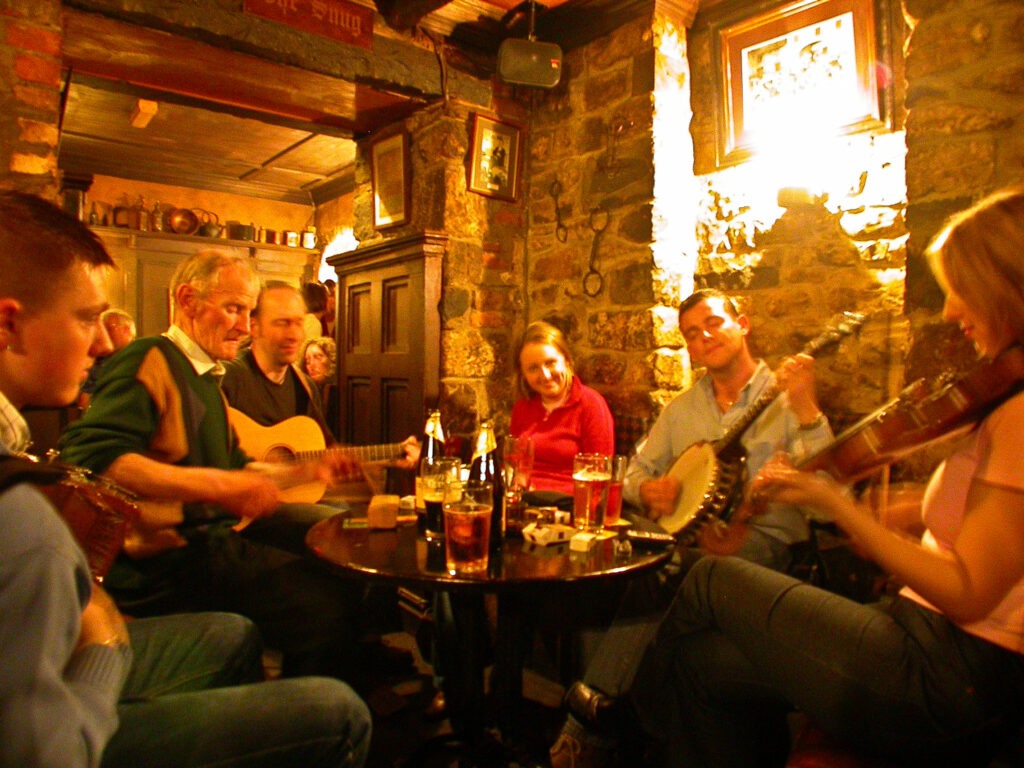
That’s how we ended up at Cruise’s. We arrived early enough for some pub grub in the back room. I was actually a bit disappointed that toasteds weren’t on the menu. (They had grown on me.) We heard the strains of a violin from near the door, so we elbowed our way to the sidelines of the session breaking out. Any time two or more musicians end up in a pub, you’ve got a session—an informal jam at a corner table, the players taking a break between songs to drain their pints.
The session at Cruise’s was being led by a fiddler in her early twenties, weaving melodies into jigs, reels, and slow airs aided by an impromptu band of button accordion, banjo, flute, guitar, and squeeze box.
The rhythm section consisted of a 15-year-old with an “L” driving learner’s sticker slapped onto his bodhran rim and a craggy guy who must have been in his eighties. A cigarette dangled from his lips, and he tapped a pair of time-bitten drumsticks first on a block of wood then on his half-empty glass of Guinness.
Sometimes, though, the tapping just didn’t do a song justice, and he’d put down the sticks and break out with a “Deedle-eye-da-diddly-eye-da-doh.”
I thought of Mossie, and wondered whom I could see about getting the old timer another pint. The song was ending, and his glass was almost empty.
LISTINGS SIDEBAR
Pubs & Cafes
John Ashe’s, Camp, Dingle, 011-353/66-713-0133
Chédéan Café, Waterville, 011-353/66-947-4966
TK Dick Mack’s, Green Street, Dingle Town, 011-353/66-915-1960 (915-1070 ?)
Foxy John’s, Main Street, Dingle Town, 011-353/66-915-1316
The Blue Bull, Sneem, 011-353/64-45-382, www.sneem.com/bluebull.html
An Droicead Beag, Lower Main Street, Dingle Town, 011-353/66-915-1723, www.thesmallbridge.com
Cruise’s, Abbey Street, Ennis, 011-353/65-684-1800
B&Bs
Bank House, Sneem, 011-353/64-45-226, www.sneem.com/bankhouse.html
Man of Aran, Kilmurvey, Inishmore, 011-353/99-61-301, homepage.eircom.net/~manofaran
Walsh’s, Lower Main Street, Dingle Town, 011-353/66-915-1147, www.iol.ie/~walshtownhouse
Greystone House, Ballymaley, Ennis, 011-353/65-684-3070, www.accommodationennisireland.com
Activities
Fahan beehive huts, Slea Head Road, Dingle, $2.50
Gallarus Oratory, Ballydavid, Dingle, 011-353/66-915-5333, $3.15
Dunbeg Fort, Slea Head Road, Dingle, 011-353)66-915-9970, $TK
Fleadh Nua, Ennis, www.fleadhnua.com
Custy’s Traditional Music Shop, Francis Street, Ennis, 011-353/65-682-1727, www.custysmusic.com
Getting There
The best airfares are usually on Aer Lingus (800-IRISH-AIR, www.aerlingus.com). You need wheels to see Ireland; in addition to the major car rental agencies, look into local firm Dan Dooley (800-331-9301, www.dandooley.com).
But vacation packages are really the way to go. Roundtrip airfare, six days’ car rental, and vouchers good for six nights at a network of 450 farmhouse B&Bs across Ireland start at $399 Dec-Mar; Apr-May it’s $799, June-Aug $949, Sept-Oct $549, Nov $479. That the price at Ireland.com (800/896-4600, www.ireland.com)—though check out rival CIE Tours (800/CIE-TOUR, www.cietours.com)—per person, based on double occupancy, out of the East Coast (departures from other US cities add $100 to $250).
The numbers provided are for phoning from the US; to call within Ireland, replace the 011-353 with a 0.